

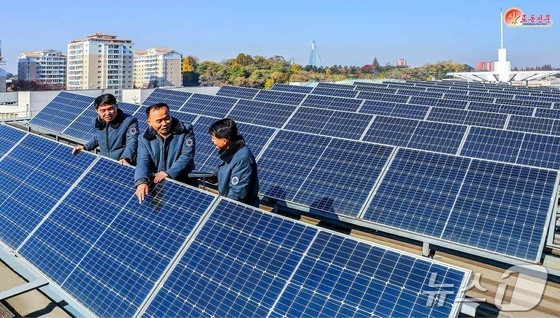
North Korea is actively promoting electricity production using renewable energy sources, including solar and wind power.
The ruling Workers’ Party’s official newspaper, Rodong Sinmun, published an article on Friday titled “Let’s Actively Utilize Natural Energy in All Regions and Units.”
The newspaper reported that while coal-fired power generation requires a significant workforce, materials, equipment, and funding, renewable energy sources are much more efficient. It also emphasized the need for increased investment to protect the environment for future generations.
The article noted that various projects are currently underway across the country to develop and utilize renewable energy actively.
In several apartment complexes in Pyongyang’s Dongdaewon and Daedonggang districts, grid-connected solar power plants are supplying electricity and hot-water heating to residents. In South Hamgyong Province, officials are completing a project to establish a hybrid power generation system using hydropower, solar, and wind energy at the Hamhung Youth No. 1 Power Plant.
The newspaper added that the underlying goal of this policy is to diversify the country’s electricity production structure, enhance its capacity, increase power generation, and improve the nation’s appearance.
North Korea’s emphasis on renewable energy production appears to be a response to its chronic electricity shortages.
Since enacting the Renewable Energy Law in 2013 and establishing the Renewable Energy Research Institute under the State Academy of Sciences the following year, North Korea has focused on utilizing renewable energy as a practical source of electricity.
In 2014, it even set a 30-year plan (2014-2044) aimed at developing 5,000 MW of renewable energy.
Notably, a report published by the Korea Institute for National Unification on Tuesday indicated that the supply of solar panels in North Korea has accelerated during the COVID-19 pandemic. As electricity demand surged, solar installations, which had previously been limited mainly to homes, are now rapidly spreading to factories and businesses.
However, there is still a long way to go before renewable energy can serve as a primary source of electricity. According to statistics released last year by Statistics Korea, in 2023, North Korea’s electricity generation capacity was comprised of 59.2 percent hydropower and 40.8 percent thermal power, while renewable energy facilities were too small to be quantified.