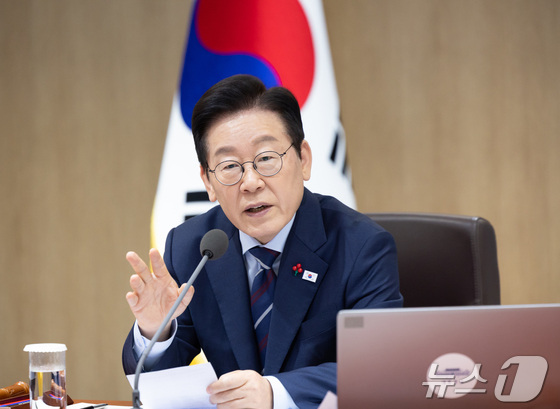
On Tuesday, President Lee Jae Myung extended olive branches to North Korea, which has remained unresponsive to dialogue attempts. He introduced the concepts of ending the war and a nuclear-free Korean Peninsula, sparking various analyses.
During the inauguration ceremony of the 22nd Democratic Peace and Unification Advisory Council, President Lee declared that it will strive to create a Korean Peninsula free from the specter of war. He pointed out that although 72 years have passed since the armistice agreement was signed, the Korean Peninsula has merely paused its state of war; genuine peace has not yet taken root.
Lee added that it will persist in the efforts to end the state of war on the Korean Peninsula, pursue a nuclear-free Korean Peninsula, and establish lasting peace. Analysts interpret this as a declaration of intent to push for a peace agreement while simultaneously expressing a commitment to achieve a denuclearized peninsula.
This aligns with the denuclearization concept presented in the E.N.D. initiative (Exchange, Normalization of Relations, Denuclearization) introduced in September. It also reaffirms the framework agreed upon by the U.S. and South Korean leaders in October in Gyeongju, which emphasizes North Korea’s denuclearization as crucial for building peace on the Korean Peninsula.
Notably, in his roughly 4,000-character speech, President Lee avoided explicitly using the term denuclearization. Analysts suggest that his choice of the phrase nuclear-free Korean Peninsula was a more diplomatic expression, especially considering that Kim Jong Un, North Korea’s leader, has demanded the abandonment of denuclearization as a precondition for resuming talks with the U.S.
President Lee revisited discussions about a declaration to end the war, a goal that previous administrations had pursued but failed to achieve.
During the Moon Jae-in administration in 2018, the leaders of North and South Korea emphasized the need to end the abnormal state of armistice on the Korean Peninsula and agreed to push for a declaration to end the war within that year. North Korea had also shown clear support for this agenda. Earlier, in 2007, during the Roh Moo-hyun administration, the Bush administration proposed the idea of a war-ending declaration, which Kim Jong Il, then North Korea’s leader, reportedly agreed to in principle.
However, after the second U.S.-North Korea summit collapsed in 2019, President Moon raised the issue of a war-ending declaration again during the 2021 United Nations (UN) General Assembly. At that time, Kim Yo-jong, a senior North Korean official, described it as an interesting proposal and a good idea, but firmly stated that discussions could not proceed unless the dual standards and hostile policies were revoked.
Despite past reactions, the current administration appears to be using the political declaration of ending the war as a means to draw North Korea back to the negotiating table. This strategy suggests a willingness to engage multiple parties, including not just the U.S. but also China, to actively address issues on the Korean Peninsula.
In this context, Professor Park Won-gon of Ewha Womans University cautioned that it it focus solely on declaring an end to the war, as was the case during the Moon administration, North Korea will not show interest. He emphasized the need for structural changes that go beyond mere declarations to include discussions on armistice and peace systems.
President Lee also underscored the importance of U.S. efforts in eliciting a positive response from North Korea. He noted that former President Donald Trump also officially committed to resolving the state of war on the Korean Peninsula during the U.S.-South Korea summit in Gyeongju. Lee pledged to work diligently to establish peace on the Korean Peninsula through U.S.-South Korea cooperation and to actively support North Korea-U.S. dialogue as a facilitator while coordinating with relevant countries.
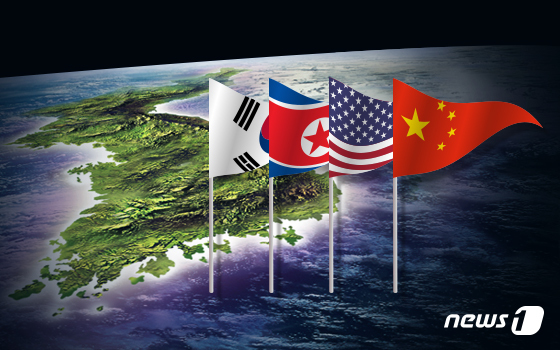
The Emphasis on a Nuclear-Free Korean Peninsula, Peaceful Coexistence, and Joint Growth Reflects a Potential Policy Priority Order
After mentioning the nuclear-free Korean Peninsula, President Lee stated that it must move toward a new era of peaceful coexistence, highlighting the need to prevent military clashes, alleviate human suffering caused by division, and restore communication channels between North and South Korea to resume dialogue.
He added that he would promote cooperation for the joint growth of North and South Korea, starting with projects addressing global concerns such as climate change, disaster safety, and healthcare, which have significant mutual demand from both sides.
The policy priorities in President Lee’s remarks appear to follow the order: nuclear-free Korean Peninsula → peaceful coexistence → joint growth.
Recent speculation suggests that the policy of a nuclear-free Korean Peninsula, which signifies denuclearization, may have been deprioritized. This ordering of priorities seems to address concerns about the government’s commitment to denuclearization.
These nuances in President Lee’s announcements reflect careful consideration of internal conflicts within South Korea as well as the complexities between the U.S. and North Korea.
Professor Park observed that denuclearization and inter-Korean exchange cooperation need to be discussed within the same context, as postponing denuclearization won’t resolve the issues. It seems this speech placed denuclearization at the forefront. He added that North Korea’s sensitivity to the denuclearization issue likely led to the use of more indirect language, such as nuclear-free Korean Peninsula.
Professor Kim Yong-hyun of Dongguk University assessed that denuclearization remains the most critical issue and serves as a vital link in all North Korea-related policies, which is why it was mentioned first to convey the message of resolving denuclearization.
The government views President Lee’s remarks more as a presentation of a vision rather than a concrete goal for North Korea policy.