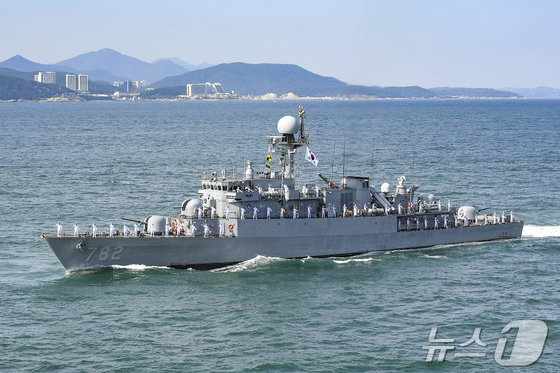
The Republic of Korea Navy announced on Friday that the Kwangmyung, a 1,000-ton patrol combat corvette (PCC) known for tracking and sinking a North Korean semi-submersible, will be decommissioned on December 31 after 36 years of service protecting South Korea’s maritime interests.
Commissioned in July 1990, the Kwangmyung is the 22nd ship in the Pohang-class series. Built at the Korea Tacoma shipyard in 1989, it has served with distinction in various naval commands, including the 1st and 3rd Fleet Commands, focusing on maritime defense operations.
The ship is equipped with a range of weapons, including 76 mm (3.0 in) and 40 mm (1.6 in) naval guns, anti-ship missiles, and lightweight torpedoes. In a notable engagement in December 1998, the Kwangmyung tracked a North Korean semi-submersible for 7 hours before neutralizing it with gunfire off the coast of Yeosu, South Jeolla Province. That operational record contributed to its selection as the Navy’s Top Gun ship in 2017, recognizing its outstanding gunnery performance.
Beyond combat missions, the Kwangmyung has also participated in critical rescue operations. In June 2015, it played a pivotal role in saving 12 crew members from a burning fishing vessel east of Sokcho, demonstrating its versatility in safeguarding civilian lives. The decommissioning ceremony, to be held under the command of Vice Admiral Kim Kyung-ryul, Commander of Naval Operations, will be attended by former captains, crew members, and key naval leadership from Jinhae Naval Base.
Vice Admiral Kim praised the Kwangmyung’s service, saying the Kwangmyung fulfilled its mission as a key asset of the fleet and protected South Korea’s waters with distinction. He added that its legacy and achievements will remain an enduring part of the Navy’s history.
Looking ahead, the Navy plans to strengthen maritime defense by replacing aging patrol vessels such as the Kwangmyung with newer guided-missile frigates. These include the 2,500-ton Incheon-class, 3,100-ton Daegu-class, and 3,600-ton Chungnam-class frigates, aimed at maintaining robust protection of South Korea’s territorial waters.