The Sunshine Policy initiated by President Kim Dae-jung in 1998 aimed to thaw relations with North Korea. At the time, President Bill Clinton publicly endorsed Kim’s North Korea policy, stating that if South Korea took the wheel in addressing Korean Peninsula issues, the U.S. would occupy the passenger seat.
However, on August 31, 1998, North Korea launched what it claimed was its first satellite, Kwangmyongsong-1, using the Taepodong-1 rocket. This prompted the U.S. to reassess its entire North Korea strategy, as the successful launch of a satellite carrier suggested an increased potential for long-range missile development.
On November 23, 1998, President Clinton appointed former Defense Secretary William Perry as his North Korea Policy Coordinator. In December, Perry visited South Korea, meeting with President Kim and his national security advisor, Im Dong-won.
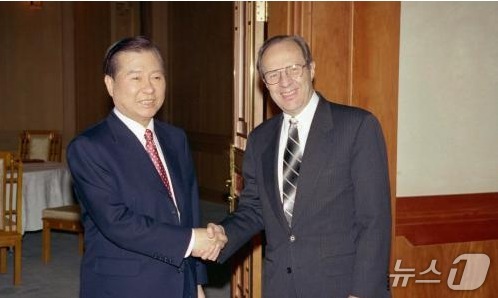
Reports suggest that South Korea and the U.S. had starkly different approaches to North Korea at this time. During a meeting with Perry on December 7 at the Blue House, President Kim spent over an hour urging him not to escalate tensions with North Korea. However, Perry returned to the U.S. without showing the response the South Korean government had hoped for. As a result, President Kim urgently sent Im to the U.S. in January of the following year.
Reflecting on his meeting with Im, Perry later remarked that he was stunned by how different the perspectives were. Nevertheless, he listened to South Korea’s views without rigidly adhering to his own approach. His insights on the Perry Process, a milestone in addressing North Korea’s nuclear program, are particularly noteworthy.
Perry candidly admitted that he’s embarrassed to say that the Perry Process was essentially a repackaging of Im’s strategic plan, expressed in American terms. The Perry Process centered on offering phased incentives to North Korea for halting its nuclear development, with stringent measures if North Korea rejected or abandoned the agreement. This strategy was finalized between the U.S. and South Korea in March 1999 and formally presented to the U.S. Congress.
In May 1999, Perry visited North Korea, and by October, then-Secretary of State Madeleine Albright traveled to Pyongyang to meet with Kim Jong Il. This visit sparked discussions about potential U.S.-North Korea diplomatic relations. In 2000, the first inter-Korean summit took place, creating momentum for resolving the North Korean nuclear issue and broader Korean Peninsula matters.
The U.S. Administration Change has Overturned the Situation… Bush’s Axis of Evil Remarks have Intensified the Conflict
In the November 7, 2000, U.S. presidential election, Democratic candidate Al Gore, who pledged to continue Clinton’s policies, won the popular vote. Gore received 50,999,897 votes, while Republican George W. Bush garnered 50,456,002. However, due to the Electoral College system, Bush emerged victorious.
The September 11 attacks in 2001 further influenced President Bush’s perception of North Korea. He adopted a hardline stance against regimes led by authoritarian leaders, including North Korea.
In January 2002, President Bush declared a war on terror, labeling Iraq, Iran, and North Korea as an axis of evil. North Korea condemned this as a declaration of war, announcing a hardline response and further straining relations.
Despite Persistent U.S. Persuasion… North Korea’s 2003 Withdrawal from the NPT Solidified the Nuclear Crisis
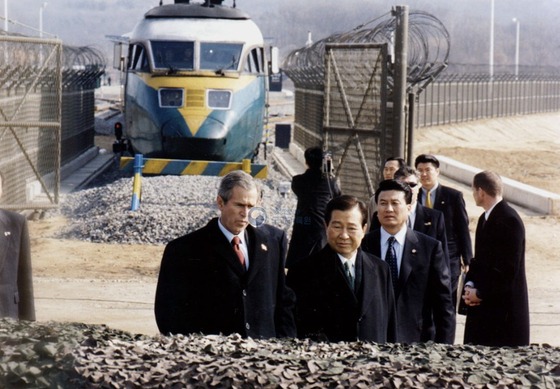
President Kim persisted in his attempts to convince the Bush administration. On February 20, 2002, during Bush’s visit to South Korea, Kim explained the unique nature of inter-Korean relations and the necessity for engagement with North Korea. He even invited Bush to visit Dorasan Station, the northernmost train station in South Korea, to witness the reality of the division firsthand. That August, South and North Korea managed to hold the Second Economic Cooperation Meeting, discussing issues like the connection of the Gyeongui Line railway and the development of the Kaesong Industrial Complex.
However, the Bush administration’s approach to North Korea shifted from dialogue and cooperation to deterrence and pressure. This change reflected the neoconservative perspective within the administration. Consequently, the momentum for inter-Korean cooperation and reconciliation stalled.
In the fall of that year, events unfolded that effectively nullified the Geneva Agreement. The Korean Peninsula Energy Development Organization (KEDO) decided to halt heavy fuel oil supplies to North Korea on November 14, 2002. In response, North Korea demanded the withdrawal of the International Atomic Energy Agency (IAEA) inspection team by the end of December 2002 and announced its withdrawal from the Nuclear Non-Proliferation Treaty (NPT) on January 10, 2003, solidifying the nuclear crisis.
The U.S. Remains the Most Critical Variable on the Korean Peninsula
The importance of the U.S. in inter-Korean relations cannot be overstated. This has been true historically and remains so today.
As the North Korean nuclear issue became entrenched, the significance of the U.S. grew even more. Addressing the inter-Korean relationship, once a bilateral issue, now requires consideration of the U.S. The North Korean problem has largely shifted into the realm of international diplomacy.
If Gore had won the presidency instead of Bush 26 years ago, would the peace on the Korean Peninsula under the Sunshine Policy have lasted longer? Could the first summit between North Korea and the U.S. have occurred in 2000 instead of 2018? As the North Korean nuclear issue seems irreversibly entrenched, these are reflections on a past that we can only imagine.