

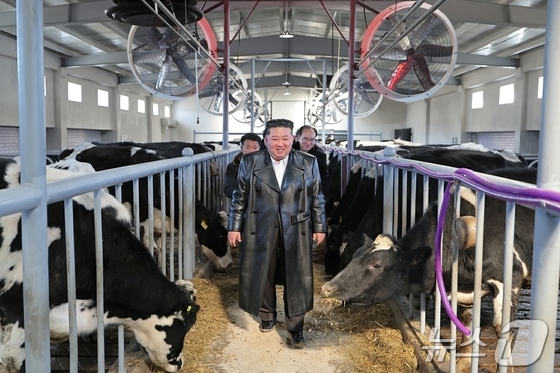
Kim Jong Un, the General Secretary of the North Korean Workers’ Party, attended the opening ceremony of the Samgwang Livestock Farm in Unjon County, North Pyongan Province. He emphasized the party’s commitment to modernizing rural areas and advancing the livestock industry.
The party’s official newspaper, Rodong Sinmun, reported on Tuesday that the grand opening ceremony of the Samgwang Livestock Farm, hailed as a model for building a new era socialist rural community and advancing the livestock industry, was held on Monday. The paper noted that Kim attended the ceremony.
According to the newspaper, the Samgwang Livestock Farm has been developed into a state-of-the-art livestock facility. It boasts modern housing, processing plants, breeding facilities, public amenities, and a solar power plant. North Korea touted this as a timely example demonstrating the legitimacy and effectiveness of its rural development policies.
In his speech, Kim stated that it is crucial for us to directly set the standards for the transformation and change it envisions. He defined Samgwang as the new benchmark and blueprint for rural and livestock modernization.
Kim praised the transformation of Unjon County’s Makbaji Valley, which was previously known only for its natural beauty. He declared that it has now become a model that visually represents the future of modern rural and livestock development, calling it a true revolution.
Kim described the Samgwang Livestock Farm as a proud achievement highlighting the work of the 8th Central Committee. He emphasized that this project is not merely for show but a new starting point to guide the future development of rural areas and livestock, setting innovative standards. He suggested that other farms could be established in rural areas based on the Samgwang Livestock Farm model.
Notably, Kim assessed that the Samgwang Livestock Farm has implemented high levels of digitalization, artificial intelligence, intensification, and industrialization. He listed achievements such as indoor breeding of dairy cows and goats, scientific management of feeding, disease prevention, and individualized animal care. He also noted the automation of milking, transportation, and processing, as well as the real-time analysis and management of production and operations through an intelligent integrated system.
He also mentioned the need to expand the production of veterinary medicines and establish research units for livestock information technology. Kim called for industry specialization alongside the introduction of advanced livestock technologies, including intelligent management systems for individual animals.
Furthermore, he presented five key elements for livestock development: securing high-quality breeding stock, ensuring sufficient feed, implementing scientific feeding management, thorough veterinary quarantine, and the digitalization and automation of production and management. He urged the farm to put in significant effort to ensure that the party’s policies yield tangible production results.
After touring the dairy production facilities, Kim remarked that they are on par with products from central facilities. He stressed the need to continuously develop the achievements in automation and digitalization of the production process. Kim highlighted the increasing industrial elements in rural areas and emphasized the need for policy support.
Kim cited the Wihwado Island greenhouse farm and the Samgwang Livestock Farm as exemplary models of vegetable production and livestock development, respectively. He stated that creating models and implementing them across the country is the approach to development. Kim had attended the completion ceremony of the large-scale Sinuiju Comprehensive Greenhouse Farm in the Wihwado Island area on February 1.
This farm opening appears to be part of the party’s New Era Rural Revolution Program and Local Development Policy, aimed at improving the quality of life for rural residents. However, the modernization project of the Samgwang Livestock Farm has drawn attention as it has not been frequently disclosed by North Korean media in the past. Kim also mentioned in his speech that this transformation of Samgwang, which has occurred without much publicity, reflects significant change.