

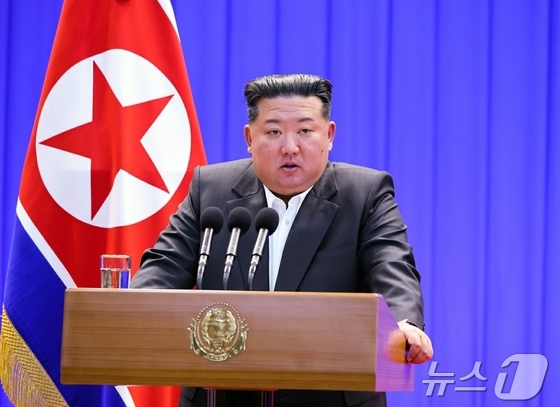
Kim Jong Un, the General Secretary of North Korea’s Workers’ Party, delivered a noteworthy speech criticizing the rural policies of his predecessors at a newly constructed large-scale livestock farm. This move is seen as breaking from the tradition of treating former leaders’ principles as sacrosanct in an effort to address food security and livelihood issues.
On Tuesday, the Workers’ Party’s official newspaper, Rodong Sinmun, published the full text of Kim’s speech, which he delivered during the inauguration ceremony of the Samgwang Livestock Farm in Unjon County, North Pyongan Province, on Monday. This project aims to modernize the aging Samgwang Livestock Farm and is part of North Korea’s years-long focus on rural modernization, including the Local Development 20X10 Policy announced in 2024.
In his address, Kim stated that the once-backward region of Unjon County has now become a model that exemplifies the future of modern agriculture and livestock farming. He lauded the transformation, declaring that a true revolution has taken place here.
He pointedly remarked that historically, the Party has proposed numerous policies on rural issues and has struggled to implement the Socialist Rural Thesis for over half a century. However, it must critically examine why its rural areas have remained impoverished.
The Socialist Rural Thesis refers to the document announced by Kim Il Sung in February 1964, which aimed to eliminate class differences between workers and farmers and promote cooperative farming systems. It has long served as the cornerstone of North Korean agricultural policy.
Kim’s remarks can be interpreted as an acknowledgment that his grandfather’s rural policies were ultimately flawed. He candidly stated that it’s no exaggeration to say that the past approach to rural development has been largely theoretical. Policies lacking practicality and feasibility are merely abstract concepts. He also criticized previous rural policies for being sporadic, temporary, and focused on appearances rather than substance.
These statements underscore that modernizing rural areas is an urgent priority and that the Samgwang Livestock Farm’s modernization will serve as a blueprint for future rural policies. Kim strongly urged officials nationwide to abandon outdated methods.
On the surface, Kim’s critique of his predecessors’ policies represents a significant departure from the long-held doctrine of infallible leadership.
Experts interpret this shift as a sign that, entering his 15th year in power, Kim has gained the confidence to solidify his own governing ideology.
Previously, on December 20, 2024, Kim acknowledged at the completion ceremony of a local industrial factory in Seongcheon County that the Socialist Rural Thesis had not been fully realized. In contrast, he praised the significant achievements of the New Era Rural Revolution Program he proposed in late 2021.
Since the 8th Party Congress in 2021, marking his 10th year in power, Kim has gradually stepped out of his predecessors’ shadow and expanded his independent policy approach. Recently, North Korean media have begun referring to Kim Il Sung’s birthday (April 15) simply as 4·15 and Kim Jong Il’s birthday (February 16) as 2·16, reflecting a trend of minimizing personality cult symbols.
Analysts predict that the upcoming 9th Workers’ Party Congress will likely establish Kim’s unique governing ideology, dubbed Kim Jong Unism. Kim’s bold and unprecedented speech reinforces expectations that significant decisions related to this new governing philosophy will emerge from the congress.
There is speculation that North Korea may officially incorporate key tenets of Kim’s governance, such as Our State First or People First, into the Party’s statutes as integral components of Kim Jong Unism.