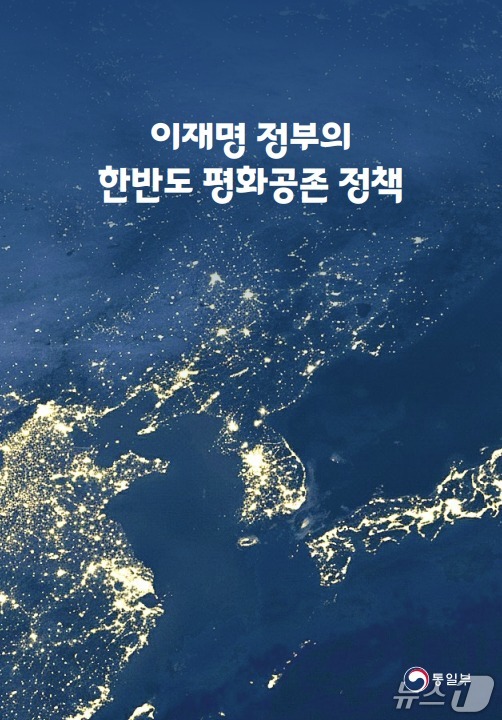
On Tuesday, the government released a guide outlining President Lee Jae Myung’s Policy for Peaceful Coexistence on the Korean Peninsula. Notably, the document does not explicitly mention the E·N·D Initiative, which President Lee introduced in his United Nations (UN) General Assembly speech last year, using the first letters of Exchange, Normalization, and Denuclearization.
The Ministry of Unification announced the nationwide distribution of this booklet explaining the policy. It will reach approximately 3,500 community centers, 12,000 schools, government agencies, media outlets, and experts.
The booklet was developed based on President Lee’s Korean Peninsula policy direction outlined in his Liberation Day speech last August 15, following discussions with relevant ministries, experts, and public input.
The government explained that the Policy for Peaceful Coexistence builds upon Ahn Jung-geun’s Theory of Peace in the East and continues the peaceful coexistence policies pursued by administrations since the 1991 Inter-Korean Basic Agreement.
The policy outlines three main goals: institutionalizing peaceful coexistence, establishing a foundation for joint growth, and achieving a nuclear-free Korean Peninsula.
It specifies three guiding principles: respecting North Korea’s system, not pursuing forced unification, and refraining from hostile actions. The policy aims for peaceful coexistence-based unification rather than unilateral absorption.
The strategy includes a comprehensive approach to exchange, normalization of relations, and denuclearization, along with open policies in collaboration with the public and international community. While this approach refers to President Lee’s E·N·D Initiative proposed in his UN speech last September 23, the term is not directly mentioned in the booklet.
Previously, concerns were raised that E·N·D could be interpreted negatively by North Korea as suggesting an end to their regime. Moon Jong-in, a former special advisor to ex-President Moon Jae-in, criticized the terminology, stating it could be misunderstood as intending to end North Korea’s system. During a Special Roundtable Discussion on Inter-Korean Relations held last December, Professor Moon, emeritus professor at Yonsei University, pointed out that the E·N·D North Korea policy could be interpreted as meaning to end North Korea, making it an unnecessary term. While its intention is to end hostile relations, North Korea or third parties could misunderstand it as ending the regime.
The omission of E·N·D Initiative in the booklet is seen as a response to these concerns. However, the policy’s substance remains unchanged, as confirmed by a Ministry of Unification official.
The fundamental direction and approach of its North Korea policy remain intact, the official stated.
The government also announced a phased approach to achieving a nuclear-free Korean Peninsula, starting with a halt in the short term, moving to a reduction phase, and ultimately realizing a nuclear-free Korean Peninsula in the long term. The use of nuclear-free Korean Peninsula instead of denuclearization appears to be a deliberate choice to avoid terminology that North Korea has shown reluctance to accept.
Additionally, the government presented six key initiatives: reestablishing inter-Korean relations focused on reconciliation and cooperation, addressing the North Korean nuclear issue, fostering public support for inter-Korean exchanges, resolving humanitarian issues, preparing for economic cooperation, and enhancing public and international engagement.