Reports on February 7 confirmed that Kim Jong Un, the General Secretary of North Korea’s Workers’ Party, significantly increased his public activities in the foreign sector in 2025, more than doubling compared to the previous year. Analysts suggest Kim is effectively leveraging his close relationship with Russia to manage the regime.
Han Gi-beom, a senior researcher at the Asan Institute for Policy Studies, and Seo Bo-bae, a researcher, presented these findings in a report titled, Assessment of North Korean Situation Based on Kim Jong Un’s Public Activities in 2025. They analyzed Kim’s public engagements over the past five years by sector.
The report shows Kim’s public activities rose from about 70 in 2021 to approximately 100 in both 2022 and 2023, then surged to 130 in 2024, reaching 153 in 2025.
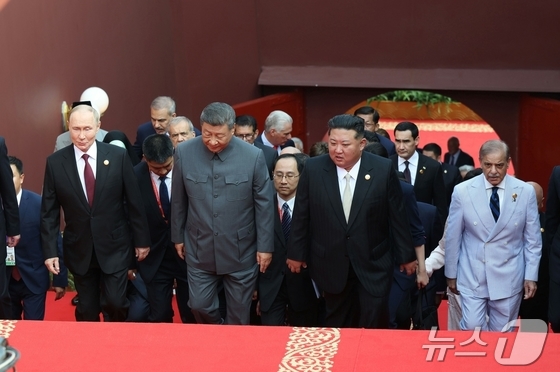
The breakdown of these activities in 2025 includes: 51 military events (53 in 2024), 37 economic events (28), 34 political events (28), 26 foreign engagements (11), and 5 social events (10). Notably, activities related to foreign interactions, such as meetings with external figures, more than doubled. Among these, there were 8 events related to Russia, 5 to China, 4 to Laos and Vietnam, and 4 categorized as others.
The report emphasized that in 2025, Kim’s foreign activities indicate a shift towards restoring relations with China while maintaining close ties with Russia. He has kept a strategic ambiguity towards the Donald Trump administration, refusing dialogue, while clearly stating that South Korea is not a dialogue partner.
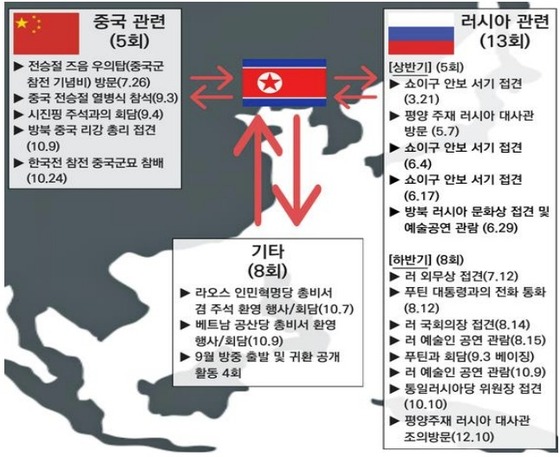
However, the pace of restoring North Korea-China relations appears slow. As the year progresses, low-level criticisms of the U.S. have resumed, with Kim’s military activities increasing, making the possibility of dialogue between North Korea and the U.S. uncertain.
While highlighting the alliance with Russia, Kim has adopted a stance of expanding economic cooperation with China. He maintains a strategic ambiguity towards the Trump administration, which he perceives as both nearby and distant.
The report notes that after the party congress, the issue of Kim’s visit to Moscow may arise. However, rather than focusing on events with Russia, the crucial question will be whether Kim’s rhetoric towards China will change to expand economic cooperation and whether the Trump administration will take any special preliminary actions for engagement with North Korea. Nevertheless, it predicts that Kim Jong Un will remain skeptical of Xi Jinping and Trump’s true intentions, likely not making significant changes to his existing calculations.
Additionally, the report states that Kim’s recent approach to regime management utilizes favorable surrounding circumstances to economically bolster the regime and expand military and diplomatic support, while driving the inter-Korean relationship into a hostile one to foster internal cohesion. It suggests that rather than engaging with North Korea, which appears unwilling to shift its stance on inter-Korean relations, it would be more effective to focus on changing the external circumstances that North Korea perceives as advantageous.