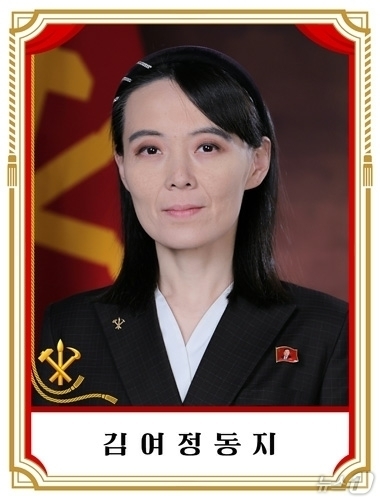
During the 9th Congress of the Workers’ Party of Korea, North Korea promoted Kim Yo-jong from deputy director to party director (minister-level) at the first plenary meeting of the 9th Central Committee. However, her specific department remains undisclosed, fueling various speculations about her future role.
On Monday, North Korea officially elected the 9th Central Committee to lead the Workers’ Party for the next five years, implementing significant personnel changes during the party congress.
According to personnel details released by the Rodong Sinmun on Tuesday, Kim not only holds the position of party director but is also included as an alternate member of the Politburo, the party’s highest decision-making body. This signifies her entry into the core decision-making structure, as alternate members rank just below standing committee members and full members.
Kim actively participated as an alternate member of the Politburo until 2020, during the denuclearization negotiations among North Korea, South Korea, and the U.S. However, her official status diminished when she was excluded from the Politburo during the 8th Party Congress in 2021.
Since the denuclearization negotiations began, Kim has taken on a significant role as North Korea’s external coordinator, actively engaging in diplomatic efforts and articulating North Korea’s official stance on major foreign policy issues. In this context, her demotion five years ago was interpreted as a consequence of the breakdown in denuclearization talks.
Consequently, some analysts suggest that Kim’s return to the Politburo and appointment as party director indicate that North Korea is taking steps to promote its external initiatives by emphasizing its Paektu bloodline.
If Put in Charge of Inter-Korean Affairs, Potential Shift in Ties… Also Seen as a Guardian for a Fourth-Generation Succession
While North Korea released the list of party central committee directors, it did not specify their particular responsibilities. Given Kim’s previous leadership in dialogues regarding South Korea and the U.S., she may oversee the party’s 10th Bureau (formerly the United Front Department) or a new department responsible for South Korea.
North Korea’s recent shift to a more aggressive external strategy, coupled with Kim Jong Un appointing his sister to lead these efforts, suggests that the regime considers South Korean affairs a significant priority. The South Korean government is likely to remain vigilant, especially as Kim has consistently released statements addressing incidents involving civilian drones infiltrating North Korea this year.
Professor Im Eul-chul from Kyungnam University’s Institute for Far Eastern Studies stated that there’s a possibility that Kim Yo Jong will officially lead external affairs, including South Korea-related matters. It appears North Korea intends to maintain its initiative in relations with the U.S. and South Korea.
However, since Kim Song-nam has continued to serve as the head of the International Department since 2021, prevailing opinions suggest that Kim’s position will not encompass oversight of North Korea’s entire diplomatic strategy.
Given Kim’s past involvement with the Organization and Guidance Department and the Propaganda and Agitation Department, if she were to become head of the Organization and Guidance Department, she might broaden her influence as a guardian for the consolidation of North Korea’s fourth hereditary succession. This personnel change also confirms that Jo Yong-won, who previously held the position, has stepped down.
If Kim becomes the head of the Propaganda and Agitation Department, she will likely be tasked with formulating and promoting policy narratives to solidify Kim Jong Un’s regime.
A South Korean Unification Ministry official told reporters that it’s difficult to predict Kim’s position and that her future actions need to be closely monitored.
Meanwhile, Kim Jong Un, the General Secretary of the Workers’ Party, did not provide any specific external or inter-Korean messages during the conclusion of the party congress following the summary report held on January 20-21. It remains to be seen whether North Korea is maintaining a strategic silence or if this behavior reflects its current external stance.