

North Korea’s approach at the 9th Congress of the Workers’ Party of Korea has raised eyebrows for its notable lack of emphasis on its close ties with Russia, its current key ally, and China, its traditional blood brother. Analysts interpret this as a strategic move to highlight Kim Jong Un’s image as a self-reliant leader and to underscore the nation’s achievements as products of self-sufficiency during this major party event.
According to comprehensive reports from the party’s official newspaper, Rodong Sinmun, Kim Jong Un’s references to Russia and China during his summary report and the adoption of resolutions at the congress were limited. He said the country should strengthen its traditional, friendly, cooperative ties with neighboring states, but avoided highlighting any specific strategic closeness. That contrasts with the party’s 80th-anniversary celebration last October, when large delegations from Russia and China attended, and North Korea–Russia cooperation was prominently featured.
The congress provided no specific details regarding North Korea-Russia military cooperation related to the deployment in the Ukraine conflict. Kim Jong Un neither mentioned the scope of cooperation with Russia nor outlined future plans. He also didn’t provide any direction on developing relations with China following his summit with President Xi Jinping last year.
Some analysts suggest that this stance differs from Kim’s previous emphasis on foreign diplomacy as a key national task.
In his summary report, Kim Jong Un said that as North Korea’s international standing has significantly risen, the importance of foreign policy work has become more pronounced, and argued that the Workers’ Party’s Central Committee must provide unified leadership to ensure diplomacy is carried out consistently. He also said that in what he described as a harsh revolutionary environment and an unusually acute international situation, the party center’s direct involvement in foreign affairs is essential, and that all external activities should proceed under its thorough, direct guidance.
The direct leadership of the party central suggests that Kim will personally oversee foreign affairs and actively engage in diplomacy as needed, indicating a focus on securing allies through proactive diplomacy this year.
While the party congress prominently mentioned foreign affairs, it did not result in any special diplomatic displays with Russia and China.
North Korea conducted this party congress to highlight achievements from the past five years and to reinforce Kim Jong Un’s unique leadership system. Rodong Sinmun even claimed that North Korea has achieved the complete victory of socialism.
Notably, one of Kim Jong Un’s signature governance policies, the “Five Major Lines of Party Construction for the New Era,” was officially incorporated into the party’s charter. This marks a significant milestone in showcasing the ‘Kim Jong Un Era’ after 15 years in power. The downplaying of foreign relations achievements may have been intentional for the sake of image building.
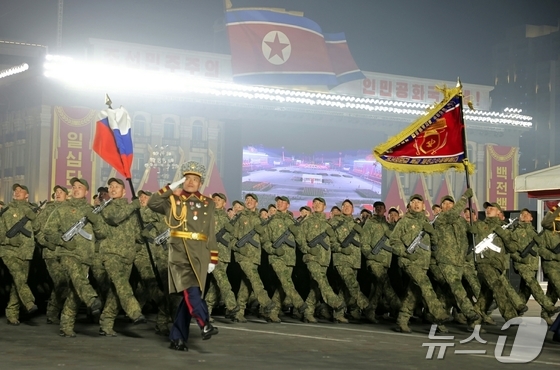
However, the military parade following the congress featured North Korean special operations forces deployed to the Kursk region to fight alongside Russia. A column carrying the Russian flag was also spotted, highlighting the closeness between North Korea and Russia. Rodong Sinmun reported that Kim Jong Un praised soldiers who died in the Russian conflict, stating that they had achieved immortal heroic feats. While North Korea-Russia closeness wasn’t prominently featured throughout the congress, the narrative of the fallen soldiers underscored the significance of their military cooperation.
The relationship with China also showed signs of being managed through diplomatic channels. On the first day of the congress, news arrived of a congratulatory message from the Communist Party of China. The People’s Daily reported on its front page on Tuesday that President Xi Jinping had sent a congratulatory message celebrating Kim Jong Un’s reappointment as General Secretary.