

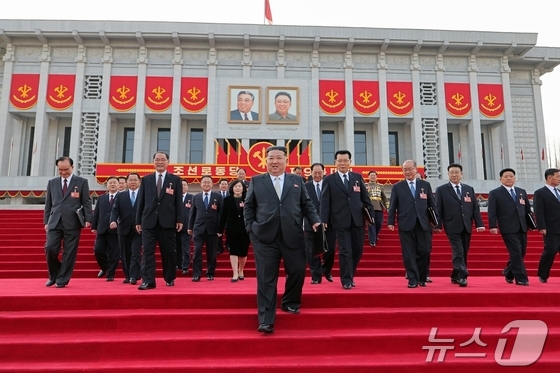
Last week, Kim Jong Un, the General Secretary of North Korea’s Workers’ Party, solidified his long-term rule during the Ninth Party Congress.
On Friday, South Korea’s Ministry of Unification reported that the congress featured several key characteristics. These included a significant reduction in references to his predecessors, praise for Kim Jong Un’s achievements surpassing those of his forebears, and the formalization of the “Five Major Party-building Lines for a New Era” in the party’s charter. The Ministry assessed that North Korea has effectively declared the dawn of the Kim Jong Un era.
In his opening remarks at the congress on February 19, Kim Jong Un notably omitted any mention of respect for his predecessors. Officials from the Party Central Committee were observed wearing badges featuring only Kim’s portrait during the congress.
The Ministry of Unification interpreted the new inclusion of Kim’s unique governance policies—such as the “Five Major Party-building Lines for a New Era” (political, organizational, ideological, disciplinary, and stylistic construction)—in the party charter as a move to cement Kim’s status beyond that of his predecessors. North Korea also defined the current moment as a period of high tide in comprehensive socialist development.
The Ministry also noted that a significant reshuffling of personnel reflected a generational change. The Secretariat of the Workers’ Party of Korea, which manages various sectors, has expanded considerably. This restructuring allows party secretaries to concurrently serve as heads of specialized departments, thereby strengthening party control and accountability.
In foreign affairs, Jang Kum Chol, who previously headed the party’s United Front Department from 2019 to 2020, appears to have returned to a prominent role by leading the External Affairs Consultative Meeting. Meanwhile, Kim Yo Jong, who has been responsible for statements directed at South Korea, has been promoted, signaling a need to closely monitor her future activities.
North Korea is maintaining its pressure campaign against the U.S. as part of its foreign strategy while pushing for a multipolar world order. The ministry said it expects North Korea to pursue a more proactive foreign policy, projecting confidence in what it views as its elevated international standing, including its nuclear capabilities and its alliance with Russia, in an effort to take a firmer initiative in international affairs.
Regarding relations with South Korea, the Ministry concluded that North Korea continues to uphold its “two hostile states” stance, first announced in December 2023, while attempting to block the peace coexistence policy proposed by the South Korean government. Kim Jong Un emphasized that the hostile stance towards South Korea and the unchanging, irreversible nature of the two-state policy are not temporary tactics but fundamental changes.
Furthermore, he indicated that North-South relations would be approached from the perspective of national interests rather than ethnic ties. Kim Jong Un insisted on a consistent approach to relations with South Korea based on cold calculations aligned with national interests and thorough responses.