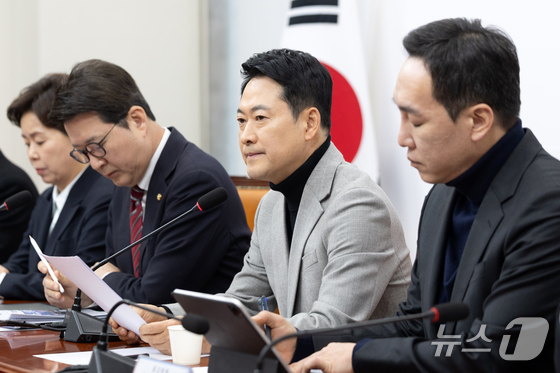
On Monday, Jang Dong-hyuk, the leader of the People Power Party, warned that the military conflict between the U.S., Israel, and Iran could foreshadow the future that North Korean leader Kim Jong Un may face.
During a Supreme Council meeting held at the National Assembly that morning, Jang stated that on February 28, the U.S. struck Iran, decimating its leadership. This action impressed upon the world the fate that awaits dictatorships obsessed with nuclear weapons.
Jang noted that as the last remaining member of the axis of evil, North Korea will likely tighten its grip on nuclear weapons and recalibrate its survival strategy. He also pointed out that however, yesterday President Lee Jae Myung declared in his March 1 Independence Movement Day speech that he would respect the North Korean regime and transition from the armistice to a peace system.
Jang criticized that this is a self-destructive security act that erodes trust with the U.S. while appearing weak to North Korea, pushing South Korea into isolation. It’s a diplomatic bankruptcy that drives the nation and its people to the brink. He added that as U.S. attention shifts from the Middle East to Northeast Asia, President Lee is preoccupied with dividing the public over real estate issues and embarking on unnecessary diplomatic tours.
Jang warned that ignoring the realities of global power competition and North Korea’s advancing nuclear capabilities while chasing a hypocritical mirage of peace will lead to an irreversible security collapse. He insisted that no political show can prevent this outcome.
He continued that history never forgives wrong choices, urging that before it’s too late, it must retract this subservient North Korea policy and refocus the government’s efforts on protecting the lives and safety of the citizens.
Jang criticized the three major judicial reform bills—criminalization of legal distortion, judicial review, and expansion of Supreme Court justices—passed by the Democratic Party, stating that March 1, 2026, when these bills are finally approved, will be recorded as the day constitutional governance in South Korea ended. He claimed that the names of all lawmakers who proposed and supported these three judicial abominations will be forever etched in the history as a disgrace.
He urged that if President Lee has any conscience at all, he must veto all three of these harmful laws, asserting that this is the only way to fulfill the constitutional duty bestowed upon the president to safeguard the constitution.