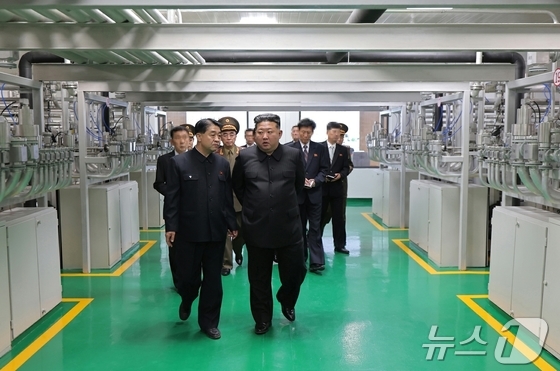
On Monday, Kim Jong Un, General Secretary of North Korea’s Workers’ Party, visited a new nuclear material production facility, believed to be a uranium enrichment site. He showcased North Korea’s nuclear material production capacity, which has reportedly more than doubled over the past five years, projecting a sense of nuclear confidence.
This marks the first time North Korea has revealed a new nuclear facility to the public. Analysts suggest this unprecedented move is likely connected to recent speculation about Chinese President Xi Jinping’s potential visit to North Korea. Despite hopes from South Korea and the U.S. that China could mediate a solution to the North Korean nuclear issue, Pyongyang appears to have no intention of relinquishing its nuclear arsenal through negotiations. Moreover, this development suggests that China may be tacitly accepting North Korea’s status as a nuclear power.
On Thursday, the Rodong Sinmun, the Workers’ Party’s official newspaper, reported Kim’s inspection of the newly operational nuclear material production plant. After touring various sections of the facility with officials from the Party’s Central Committee and the nuclear weapons research institute, Kim declared that under the direct guidance of the 8th Central Committee (2021-2025), the nuclear weapons production capacity has more than doubled over the past five years.
While the newspaper did not disclose specific details about the facility’s location or production capacity, published photos reveal rows of long cylindrical centrifuges necessary for uranium enrichment, indicating the facility’s purpose is high-enriched uranium production.
The South Korean government believes this facility is likely a new uranium enrichment site constructed in Yongbyon, North Korea’s largest nuclear complex, between 2024 and 2025.
Three Nuclear Facilities Revealed in 18 Months: Showcasing Nuclear Strength and Rejecting Denuclearization
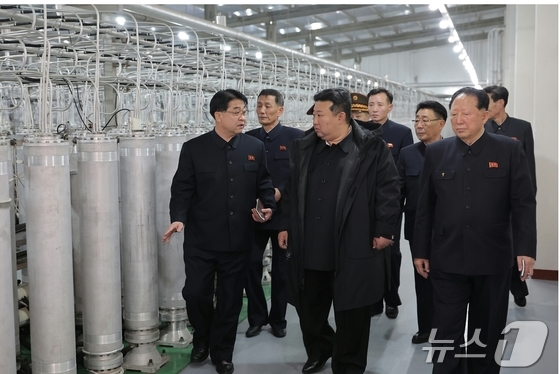
North Korea has unveiled three nuclear facilities in the past 18 months, showcasing its nuclear capabilities while distancing itself from denuclearization efforts. This marks the third time North Korean media has disclosed facilities related to uranium enrichment. In September 2024, Pyongyang reported on Kim’s visit to a nuclear weapons research institute and weapons-grade nuclear material production base, revealing a weapons-grade uranium manufacturing facility for the first time. The International Atomic Energy Agency (IAEA) suspects this facility is located within the Kangson complex near Pyongyang. In January of last year, North Korean media also reported Kim’s inspection of a nuclear materials-related facility, believed to be in Yongbyon.
The most significant aspect of this recent report is the mention of a newly operational nuclear material production facility. The emergence of a new uranium enrichment site indicates that North Korea is substantially increasing its production of nuclear materials for weapons use. Currently, known locations of North Korean uranium enrichment facilities include Yongbyon in North Pyongan Province, Kangson in Nampo, and Goseong in North Pyongan Province. These facilities are expected to continue expanding.
In June of last year, the IAEA reported that a new building, believed to be a uranium enrichment facility, was under construction in Yongbyon. IAEA Director General Rafael Grossi reaffirmed this information in April during a press conference in South Korea, stating that the agency is aware of new nuclear facilities being built in Yongbyon.
During his recent inspection, Kim advocated for the necessity of nuclear development policies, signaling his intention to further strengthen this approach.
He stated that during the 9th Party Congress held in February, a new five-year plan emphasizing nuclear weapons enhancement was adopted. Kim declared that it has made a strategic decision to expand our nuclear material production capacity and continue increasing the nuclear arsenal. This recent inspection suggests that North Korea is actively implementing this party-level decision.
Kim further asserted that the revolution’s unique circumstances require us to engage in a long-term confrontation with the most brutal adversaries, describing nuclear weapons as the fundamental guarantee that reliably secures the nation’s safety, interests, and right to development.
Analysts interpret his remarks as an attempt to solidify North Korea’s status as a nuclear power while distancing itself from international denuclearization discussions. Notably, the phrase long-term confrontation emphasizes North Korea’s lack of interest in denuclearization or nuclear disarmament through dialogue with South Korea and the U.S.
Experts suggest that the unveiling of nuclear facilities sends a strong political message aimed at the recent U.S.-China talks.
The U.S. mentioned the goal of North Korea’s denuclearization during the mid-April summit with China, and some analysts interpret the unveiling of North Korea’s new nuclear facility as a response to this. After the meeting between President Xi Jinping and President Donald Trump in Beijing on April 14-15, the White House announced that the two leaders confirmed their shared goal of denuclearizing North Korea.
At that time, the Chinese Foreign Ministry offered a somewhat vague statement, saying that China’s position and policy maintain continuity and stability.
Amid this backdrop, rumors of Xi’s visit to North Korea are gaining momentum. Recent satellite images suggest the installation of a large structure, likely used for ceremonial purposes, at Kim Il Sung Square in Pyongyang when high-ranking foreign guests visit. Additionally, it has been confirmed that a large aircraft has been newly deployed on Air China’s Pyongyang route.
Xi may visit North Korea next month to mark the 65th anniversary of the North Korea-China Friendship Treaty on July 11. Analysts believe that North Korea’s bold unveiling of the new nuclear facility is possible because China appears to tacitly endorse North Korea’s claims as a nuclear power.
From North Korea’s perspective, there is a need to showcase that China supports its status as a nuclear power in light of Xi’s potential visit, suggesting that Kim’s inspection of the new nuclear facility was a politically motivated decision.
Following President Trump’s visit to China, Xi met with Russian President Vladimir Putin in Beijing on April 20, where they criticized U.S. hegemony and opposed international sanctions and pressure against North Korea. This indicates that North Korea perceives support from both major powers.
Hong Min, a senior researcher at the Korea Institute for National Unification, noted that while the U.S. continues to discuss denuclearization and related topics were addressed during the U.S.-China summit, North Korea’s unveiling of the new nuclear facility primarily serves as a political message to the international community to say, Do not talk about denuclearization.