

President Donald Trump’s aggressive actions to dismantle the Iranian regime led by Ayatollah Ali Khamenei have pushed the Middle East to the brink of crisis. Experts predict that North Korea will view this situation with heightened concern. The crisis has escalated beyond a point where simply increasing anti-U.S. sentiment would suffice as a response.
Unlike Venezuela, Iran possesses nuclear capabilities. The U.S. has demonstrated its willingness to directly target such nations and remove their leadership. Analysts note that if President Donald Trump were to propose another round of talks, Kim Jong Un, North Korea’s leader, would face a complex strategic dilemma.
Oppose and Eliminated – North Korea Tenses as Trump’s Regime Change Diplomacy Unfolds
The Trump administration recently executed Operation Epic Fury, a precision airstrike targeting Iran’s Supreme Leader, Khamenei. After confirming the deaths of Khamenei and over 40 Iranian leaders, Trump declared it a golden opportunity for the Iranian people to reclaim their country, clearly signaling his intent to oust the regime.
This military action against the leader of a near-nuclear state demonstrates America’s willingness to take extreme measures to neutralize perceived existential threats.
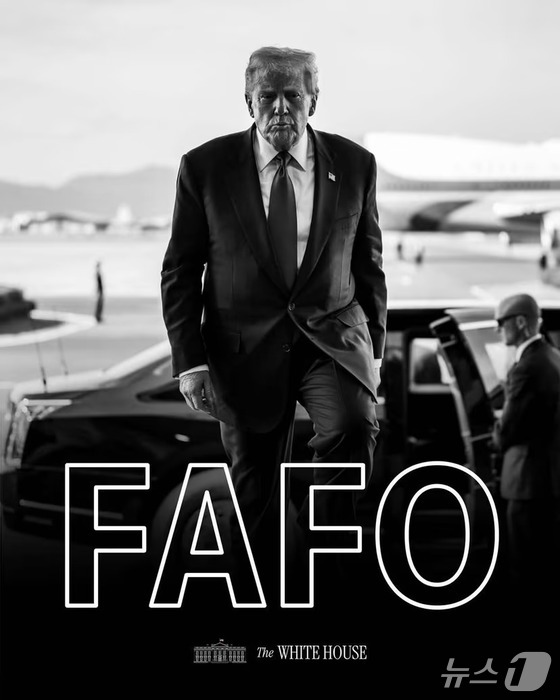
This incident follows the January 3 Operation Absolute Resolve in Venezuela, which resulted in the capture of President Nicolás Maduro and his wife. The White House marked the occasion by posting a photo of a determined-looking Trump with the caption “FAFO” (F*** Around, Find Out) – a clear warning of his administration’s hardline approach.
During the Maduro ouster, experts believed North Korea might not feel directly threatened, given Venezuela’s lack of nuclear capabilities. They predicted Pyongyang would instead focus on enhancing its own nuclear deterrent.
However, the successful operation against Iran’s leadership, despite their significant nuclear progress, likely forces North Korea to reassess its strategy. If Trump views the North Korean threat as critical or communication impossible, a similar scenario could unfold on the Korean peninsula.
On March 1, North Korea’s Foreign Ministry condemned the U.S.-Israeli operation as an unlawful invasion and heinous violation of sovereignty. Notably, state media withheld details of Khamenei’s death from the public, highlighting the regime’s complex position.
This response reveals Pyongyang’s dilemma: they must counter U.S. aggression while preventing potential internal instability that could arise if citizens learn of another dictator’s downfall. North Korea similarly suppressed news of Maduro’s capture.
North Korea at a Crossroads: Double Down on Nukes or Seek Talks?
During the recent Party Congress, Kim demanded the U.S. withdraw its hostile policy and recognize North Korea as a nuclear power before any dialogue. He lambasted America as a rogue state with an invader’s nature.
While this rhetoric reflects North Korea’s increased confidence since the 2018 summit, Trump’s actions against Iran have complicated Pyongyang’s calculus.
Experts believe North Korea now faces two conflicting options. They may accelerate nuclear development, viewing Iran’s fate as proof of the need for a stronger deterrent. Alternatively, they might seek negotiations to mitigate the threat posed by Trump’s unpredictability.
If North Korea perceives Trump’s stance as increasingly hostile, they may rush to deploy and diversify their nuclear arsenal. Conversely, they might pursue talks to prevent a potential U.S. military response. The shift from Let’s talk to Are you really refusing dialogue? could pressure Pyongyang to engage.
Another possibility is that North Korea will strengthen ties with Russia and China while enhancing its nuclear capabilities. This united front could deter U.S. intervention. Simultaneously, North Korea might escalate provocations against South Korea to reinforce the idea that any attack on the North would have devastating consequences for the South.
Professor Park Won-gon of Ewha Womans University notes that North Korea may double down on nuclear development while also considering dialogue to manage risks, given Trump’s extreme unpredictability.