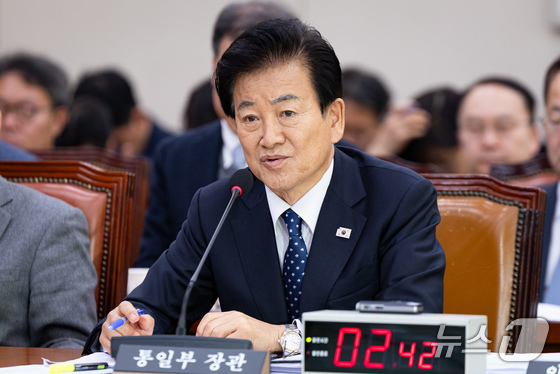
The Ministry of Unification announced that despite North Korea’s hostile two-state stance, it will continue to pursue a policy of peaceful coexistence aimed at reducing tensions on the Korean Peninsula. The ministry plans to create conditions for resuming U.S.-North Korea dialogue while simultaneously working to build trust and promote exchanges and cooperation for inter-Korean talks.
During a report to the National Assembly’s Foreign Affairs and Unification Committee on Friday, the ministry stated it would adhere to the three principles of peaceful coexistence: respecting North Korea’s regime, refraining from hostile actions, and rejecting forced unification. The ministry aims to reduce tensions and foster an environment conducive to dialogue. It plans to restore inter-Korean communication channels and implement measures to ease military tensions to pave the way for renewed talks.
The Ministry of Unification emphasized its ongoing efforts to build trust for reestablishing peaceful coexistence in inter-Korean relations. It highlighted its swift response to North Korean incursions involving civilian drones, which prevented an escalation of tensions between the two Koreas.
Regarding the 9th Congress of the Workers’ Party of Korea, held from February 19 to 25 at the April 25 House of Culture in Pyongyang, the ministry assessed that General Secretary Kim Jong Un has solidified the foundation for his long-term rule by strengthening the system of singular leadership.
During this party congress, North Korea reorganized its party leadership structure, made personnel changes, and outlined policies for economic and military sectors. In the economic realm, it introduced a new five-year plan and mentioned the development of new technologies in energy, space, and artificial intelligence. The military sector emphasized strengthening both nuclear and conventional capabilities.
Notably, General Secretary Kim referred to South Korea as the main enemy during the congress, reaffirming the two-state stance. Regarding foreign relations, he indicated that North Korea-U.S. relations could change depending on Washington’s attitude, leaving room for conditional dialogue.
In response, the Ministry of Unification stated that the U.S. has confirmed its willingness to engage in dialogue with North Korea without preconditions. The ministry emphasized its commitment to act as a facilitator in creating favorable conditions for a North Korea-U.S. summit.
The ministry also plans to explain its policy of peaceful coexistence to relevant countries such as the U.S., China, Japan, and Russia, and pursue consultations. It will emphasize to the United States the necessity of appointing a special representative for North Korea.
The Ministry of Unification reaffirmed its commitment to existing plans, including a continental railway connecting Seoul, Busan, and Pyongyang to Beijing. It reiterated its intention to present comprehensive incentives that consider North Korea’s needs in political, military, and economic areas, as part of its Korean Peninsula Peace Package initiative.