North Korea has maintained a system where the party governs above the state since the regime’s inception. In accordance with the Workers’ Party charter and the constitution, it is a structure where the party guides and dominates the state. Given the characteristics of a one-party ruling system, the Workers’ Party Congress (Party Congress), the highest decision-making body of the party, can be seen as the political event with the most significant impact on North Korean society. This is why it’s crucial to closely analyze the results of North Korea’s recently held 9th Workers’ Party Congress.
Kim In-tae, a senior researcher at the Institute for National Security Strategy (INSS), who met with News1 on March 5, emphasized the importance of analyzing the Party Congress based on the path dependency of the hereditary party that has continued for 80 years. Kim, a North Korean defector who once served as the first secretary of the Youth League in Yanggang Province, has been analyzing and documenting changes in North Korea at the INSS, a research institute under the National Intelligence Service.
Kim noted that Kim Jong Un, facing his third Party Congress since taking power, is strengthening the party’s governing logic while also making the monolithic system more rational through policy failures and trial and error exposed in the previous two Party Congresses. He particularly emphasized the need to watch the policy decisions of the 9th Party Congress, which focused on strengthening the regime while promoting the comprehensive development of Kim Jong Un-style socialism, and the subtle changes that follow.
Rational Coordination of Laws and Systems… Emphasis on Efficiency in Power Restructuring
North Korea, while focusing on follow-up measures after the 9th Party Congress, officially announced on the 4th that it will hold the 15th Supreme People’s Assembly election on the 15th of this month. This is the first time under the Kim Jong Un regime that the 5-year cycle of the Party Central Committee meeting, as stipulated in the party charter, coincides with the 5-year term of the Supreme People’s Assembly as per the constitution. The 14th assembly was elected in March 2019, but with the 8th Workers’ Party Congress held two years later in 2021, they faced difficulties in restructuring the power structure. Since the party designs all state power in North Korea, it seems they judged that the power structure and policy-making system were not rational in terms of regime operation.
Kim explained that much can be inferred from the fact that the 15th Supreme People’s Assembly member election was delayed by about two years. This is fundamentally a manifestation that appeared in the process of trying to coherently align the Workers’ Party-centered operating system.
The Supreme People’s Assembly, North Korea’s sovereign body exercising legislative power, is an institution that ratifies the party’s decisions into law and personnel appointments for state organs. Therefore, it can be seen as a rational format to first confirm the national policy and leadership at the Workers’ Party Congress and then organize state organ personnel through the Supreme People’s Assembly.
In his policy speech to the Supreme People’s Assembly in January 2024, Kim Jong Un mentioned the need to amend the constitution to reflect territorial clauses, including the issue of incorporating South Korea into the republic’s territory in case of war, stating that this should be deliberated in the next Supreme People’s Assembly. Then in June of the same year, the Supreme People’s Assembly adopted the Deputy Law specifying the responsibilities and roles of members, but did not mention the already delayed 15th election schedule.
The schedule for the 15th Supreme People’s Assembly deputy election announced on March 5 does not even comply with the current election law regulations of North Korea. According to the election law amended in 2023, the Supreme People’s Assembly election schedule is to be announced by the Standing Committee’s decision 60 days in advance. However, this time it was announced in an abbreviated form just over 10 days in advance.

Kim explained that while the five-year term of Supreme People’s Assembly deputies can be extended in case of unavoidable circumstances according to Article 90 of North Korea’s Socialist Constitution, the reason for the term extension this time differs from the past.
Since the establishment of the North Korean regime in 1948, the Supreme People’s Assembly elections were mostly delayed when major political events occurred, such as the Korean War and the death of Chairman Kim Il Sung in 1994. However, the intention behind extending the term of the 14th Supreme People’s Assembly is likely aimed at more rationally reorganizing the regime’s operational structure, according to the analysis.
In this process, Kim’s analysis suggests that it’s necessary to pay attention to the fact that Choe Ryung-hae, the Chairman of the Standing Committee of the Supreme People’s Assembly and officially second in the North Korean protocol order, was omitted from the list of the 9th Party leadership.
According to the North Korean constitution, the Chairman of the Standing Committee of the Supreme People’s Assembly should be elected or dismissed by the Supreme People’s Assembly, but this time, the party personnel changes were made first, and then it seems these will be finalized in the Supreme People’s Assembly. This suggests that this system is likely to take root in the future.
What Does Kim Yo-jong’s Promotion Mean… Core Competency Operation Based on Inner Circle
Along with Choe, the figure who received much attention was Kim Yo-jong. During the 9th Workers’ Party Congress, at the 1st Plenary Meeting of the 9th Central Committee, Kim Yo-jong was promoted from party vice department director to party department director (ministerial level), significantly elevating her political status.
Kim analyzed that Kim Yo-jong’s promotion is a measure to solidify Kim Jong Un’s monolithic leadership system and the party-centered ruling system. Since Kim Jong Un’s rise to power, North Korea has emphasized policy-making and execution structures through the party, and in this process, there has been a trend of placing trusted confidants in key party positions to enhance policy execution and manage the power structure more stably.
Kim defined the group of confidants who play important roles in policy execution and power operation based on the supreme leader’s trust as the inner circle, and viewed that Kim Yo-jong has established herself as a core figure of the inner circle in the policy-making process, beyond her blood relationship as Kim Jong Un’s younger sister, receiving absolute trust from Kim Jong Un.
The rise in Kim Yo-jong’s power was also well evidenced in a Rodong Sinmun report late last year. For the first time, it was publicly revealed that Kim Yo-jong personally sent a porcelain gift to the president of Russia’s TASS news agency. Kim analyzed that it is very unusual for the fact that someone other than the supreme leader officially sent a gift to a foreign figure to be made public.
There are about 20 specialized departments in the Party Central Committee, and the General Affairs Department that Kim Yo-jong is in charge of generally plays a role similar to the planning and coordination office that manages internal party affairs. Given that one of the most prominent scenes in Kim Jong Un’s recent activities has been the dismissal of officials on-site, we can guess what Kim Yo-jong will be managing in the future. Combining the characteristics of the General Affairs Department’s work with Kim Yo-jong’s power, it is expected that while the guidance departments of the Party Central Committee such as the Organization and Guidance Department will guide the entire party and society as a whole, the General Affairs Department will manage and control all these guidance departments.
North Korea previously revised the party charter at the 8th Workers’ Party Congress, using the term tenure for party officials for the first time. Kim interpreted this as reflecting the will to strictly consider the responsibility and competence of officials when appointing them and hold them accountable when necessary.
This trend is reflected in the number of Party Central Committee members who attended this congress. In the past, they tried to ensure all 250 members and candidate members of the Party Central Committee attended the opening ceremony, but this time North Korea announced that only 224 out of 250 attended the opening ceremony. Kim analyzed that 26 were likely pre-eliminated, and the fact that these positions were not refilled indicates a shift towards a responsible tenure system, implying the message give up your position if you can’t fulfill your duties.
He added that North Korea’s introduction of a system to nominate and vote on multiple candidates at the candidate selection stage for the first time in the local people’s assembly deputy elections held in November 2023, through the revision of the election law, is in the same context.
Meanwhile, Ju Ae, Kim Jong Un’s daughter who frequently appears in his public activities, did not show up during the party congress period but only attended the military parade held after the congress ended. Kim pointed out that it was unreasonable to associate Ju Ae with the party congress at this stage. This is because the focus of this party congress was on strengthening the Kim Jong Un system, and Kim Jong Un’s leaderization is still ongoing.
The important criterion to focus on regarding the succession issue should be Kim Jong Un, not Ju Ae. The key indicators are how far Kim Jong Un-centered governance structure, chronology, and absolute status have progressed. Although Kim Jong Un is in his 15th year of rule, from the perspective of a monolithic ruling system, he can still be considered in the early stages of his reign.
Political messages are also reflected in the Party Congress stage production that can be easily overlooked. Kim particularly pointed to the background of the presidium and the composition of the podium as representative elements showing the concept of the party congress.
The key to the presidium background lies in what is placed behind the stage where the presidium is set up. Kim explained that the symbolic objects placed have changed according to the times.
According to Kim, during the 1st to 4th Party Congresses held in the Kim Il Sung era, the basic approach was to place Workers’ Party slogans or party flags behind the presidium. Later, at the 5th Party Congress (1970), Kim Il Sung’s portrait appeared in the center of the presidium for the first time, which Kim pointed out can be seen as a symbolic scene showing that the personal cult of Kim Il Sung was institutionally strengthened.
Until the 4th Party Congress, the dictatorship and personality cult (of Kim Il Sung) were not fully completed. But the 5th Party Congress signaled that the personality cult was complete and a successor had emerged and was active. It wasn’t Kim Il Sung himself saying, I’m going to put my portrait up there, but rather his successor creating an atmosphere of its going to elevate the Supreme Leader. Fundamentally, the successor has an obligation to serve the Supreme Leader.
Kim Il Sung’s portrait was also placed on stage at the 6th Party Congress, and at the first Party Congress (7th) after Kim Jong Un took power, emphasizing Kimilsungism-Kim Jong Ilism and highlighting the legitimacy of the regime, portraits of Kim Il Sung and Kim Jong Il were placed in the stage background. In contrast, at the 8th and 9th Party Congresses, which highlighted Kim Jong Un’s confidence, party flags and the Workers’ Party emblem were placed in the stage background instead of leader portraits.
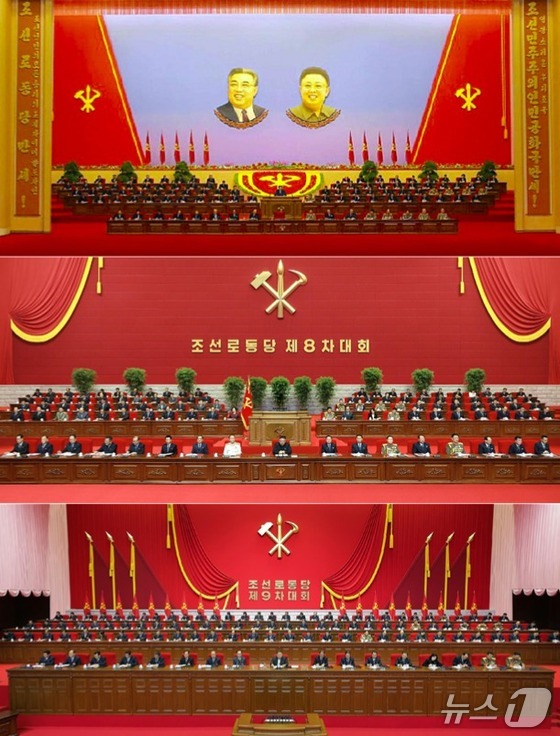
This party congress can be seen as designed to formally maintain the framework of inheriting Kimilsungism-Kim Jong Ilism while actually emphasizing the status and authority of the Kim Jong Un era Workers’ Party in its political message. Kim also analyzed that the more sophisticated arrangement of the presidium composition and stage production reflects the intention to emphasize the authority and status of the Workers’ Party.
Removal of Independent Reunification of the Fatherland Expression from Work Review Presentation Structure
At the party congress, a work review report summarizing the past five years’ work is first presented. Kim pointed out that we should pay attention to the fact that the expression ‘independent reunification of the fatherland’ was officially removed from the work review presentation structure at this 9th Party Congress.
In the past, North Korea used to specify For the independent reunification of the fatherland and the development of foreign relations in the work review report structure, combining policies towards South Korea and foreign policies, but this expression disappeared at this party congress.
Kim assessed that although the full text of the revised party charter hasn’t been disclosed, this change clearly shows the stance of codifying two hostile states. The traditional reunification of the fatherland task that North Korea has traditionally maintained in the party congress work review report structure, which evolved from For the independent reunification of the fatherland (7th Congress) to For the independent reunification of the fatherland and the development of foreign relations (8th Congress), was reduced to just For the strengthening and expansion of foreign relations (9th Congress) at this party congress. This reflects the strategic perception that North-South relations will no longer be approached as a unification issue.
Also, this time Kim Jong Un, while stating his position on South Korea, emphasized that the stance towards South Korea was an important party-level decision by proclaiming it again through the party congress, the highest governing body of the ruling party that determines the nation’s policy and direction. Regarding this, Kim said that it shows that North Korea has codified its strategy towards South Korea in the party charter from a mid to long-term perspective, mentioning the process through which North Korea has justified its nuclear policy through legislation.
North Korea has been institutionalizing its policies step by step in the process of justifying its nuclear policy. It starts with policy assertions, then moves to legislation and constitutionalization, eventually making it an irreversible national policy. The statement at this party congress that ‘the current state where conditions for connection with South Korea have been completely removed will be made permanent’ should also be understood in the context of this policy institutionalization process.
Kim also noted that North Korea’s method of disclosing party congress information is changing. Until the 7th Party Congress, the full text of the work review report was disclosed, allowing for a relatively clear understanding of the policy structure, but recently, there’s a tendency to limit detailed content understanding as summaries are mainly disclosed.
He explained that North Korea appears to be intentionally managing party congress information and adjusting the level of disclosure to the outside world. The fact that they didn’t disclose the specific titles of the Party Central Committee department directors appointed at this party congress can be understood in the same context.
Kim said that an important point to watch in the future is to what extent North Korea will institutionalize the two-state relationship in the process of codifying it in the constitution. As North Korea is moving towards officially and institutionally establishing hostile state relations, the response to this should also be consistently pursued from the perspective of a mid to long-term Korean Peninsula peace coexistence policy and North Korea strategy, rather than short-term changes.
He suggested that whether North Korea will include detailed regulations such as territorial clauses beyond simply specifying the definition of state relations could be a criterion for gauging the future structure of inter-Korean relations. However, Kim predicted that since constitutions generally have a strong character of defining macroscopic directions, detailed implementation measures might be adjusted through subordinate laws.