

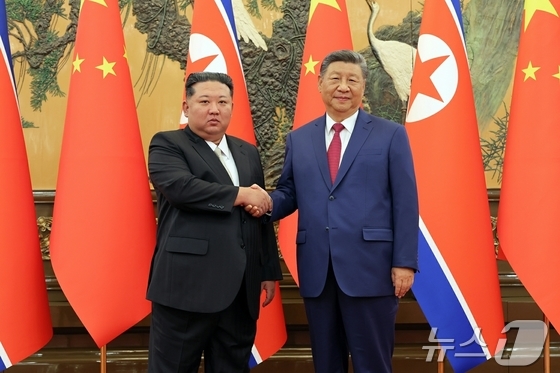
Recently, the exchange of letters between Kim Jong Un, General Secretary of North Korea’s Workers’ Party, and Chinese President Xi Jinping has garnered significant media attention in both countries. As U.S. President Donald Trump’s visit to China approaches at the end of this month, analysts suggest that North Korea and China have reached a consensus on improving relations or managing the situation.
Some experts believe that the need for close communication between the North Korean and Chinese leaders has intensified in light of recent events, such as the U.S.-Israeli airstrikes on Iran and Trump’s upcoming China trip.
After No Mention of Xi in January… A Shift in Rodong Sinmun’s Coverage
The Workers’ Party’s official newspaper, Rodong Sinmun, featured Kim’s full reply to President Xi on its front page. This response followed Xi’s congratulatory message on Kim’s reappointment as General Secretary at the 9th Workers’ Party Congress last month.
In his reply, Kim expressed profound gratitude for Xi’s warm congratulations. He also conveyed an optimistic message about North Korea-China relations, stating that he believes the two parties and countries will forge even closer cooperation as it advances the shared socialist cause.
Although concise at 305 characters, Kim’s reply emphasized that steadily strengthening and developing the traditional friendship between China and North Korea, in line with the new era’s demands and the peoples’ aspirations, remains the unwavering stance of the party and government. This indicates that the relationship continues to be one of friendly cooperation aimed at mutual development.
Previously, in a February 23 congratulatory message, Xi described China and North Korea as friendly socialist neighbors who support each other, asserting that maintaining, strengthening, and developing China-North Korea relations is the consistent policy of the Chinese Communist Party and government.
On February 24, Rodong Sinmun reported Kim’s reappointment on its front page, prominently featuring Xi’s congratulatory message before others from various countries. Notably, Xi’s message was given precedence over those from Russia’s ruling United Russia party, led by Dmitry Medvedev, and the leaders of Vietnam and Laos, underscoring its significance.
China’s People’s Daily also highlighted the event, placing an article titled, Xi Jinping Congratulates Kim Jong Un on His Reappointment as General Secretary of the Workers’ Party of Korea, at the top of its front page, presenting the full text of Xi’s message.
Xi’s message included the phrase China and North Korea are socialist friendly neighbors who help each other in times of difficulty, which is viewed as a more proactive statement compared to Kim’s description five years ago of the two countries as socialist friendly neighbors connected by mountains and rivers.
Xi further noted that they’re witnessing unprecedented global changes, with an increasingly complex international situation. He expressed his willingness to collaborate with Kim to actively contribute to promoting peace, stability, development, and prosperity in the region and the world, clearly positioning North Korea as a diplomatic partner.
In January, North Korea merely acknowledged that Kim had sent New Year’s greetings to several countries, including China, without specifically naming Xi or revealing the contents of the messages. However, the situation appears to have shifted significantly in just over a month.
Strategic Calculations Ahead of Trump’s China Visit… North Korea and China Managing Each Other
Experts suggest that with Trump’s visit commencing on March 31 and ongoing discussions about potential U.S.-North Korea dialogue, the North Korean and Chinese leaders likely felt compelled to communicate to reaffirm their relationship and manage the Korean Peninsula situation.
Moreover, as the U.S. pursues aggressive policies this year, including efforts to oust Venezuela’s Maduro regime and conducting large-scale military operations against Iran alongside Israel, Kim and Xi may feel the need to demonstrate their strengthened ties as they build an anti-U.S. coalition.
Professor Lim Eum-chul from Kyungnam University’s Institute for Far Eastern Studies commented that while the North Korea-Russia relationship is currently solid, the North Korea-China relationship remains fluid, subject to changes in the international landscape, particularly U.S. actions. He added that Kim and Xi seem to be maintaining a balanced friendship, neither too distant nor too close, as they carefully manage their relationship.