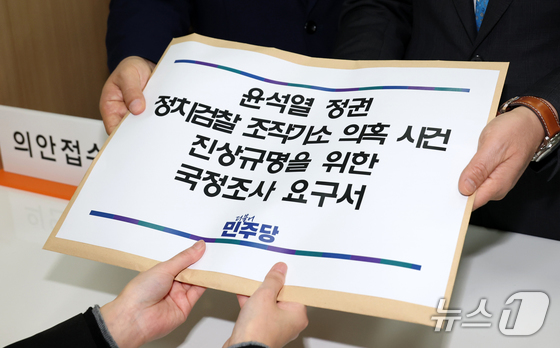
The Democratic Party is set to launch a national investigation into the prosecution’s decision to indict President Lee Jae Myung over allegations related to North Korean remittances by Ssangbangwool. The party claims there are issues with the prosecution’s decision and is calling for the dismissal of charges.
Legal experts have raised concerns that this investigation, which aims to interfere with ongoing trials, may violate the law. This has led to speculation that the ruling party’s investigation could face significant obstacles.
According to political sources on Friday, the Democratic Party plans to submit a proposal for a national investigation into alleged manipulation in the prosecution of the Yoon Suk Yeol administration during an upcoming National Assembly plenary session.
Since around 3:00 p.m. (Korean time) the previous day, members of the People Power Party have been engaged in a filibuster, opposing the ruling party’s proposal to amend the Public Prosecution Service Act. The Democratic Party intends to end the filibuster after 24 hours through a vote, as per National Assembly rules, and proceed with the national investigation proposal.
The ruling party has identified seven cases suspected of manipulation during the prosecution’s investigation and indictment process for the national investigation.
The investigation will cover seven cases: the Daejang-dong development preferential treatment case, the Wirye New Town development corruption case, the political funds bribery case involving former Democratic Research Institute Deputy Director Kim Yong, the Ssangbangwool North Korea remittance case, allegations of manipulated real estate statistics during the Moon Jae-in administration, the incident involving the shooting of a public official in the West Sea, and the defamation case against former President Yoon Suk Yeol related to reports on the cover-up of the Busan Savings Bank investigation.
Three of these cases (Daejang-dong development preferential treatment, Wirye New Town development corruption, and Ssangbangwool North Korea remittance) were indicted before President Lee’s election.
Legal experts have pointed out that conducting a national investigation into cases currently under investigation or trial is inappropriate and may violate the law.
The National Assembly Act on National Audit and Investigation stipulates that a national investigation should not be conducted to infringe on an individual’s privacy or interfere with ongoing trials or investigations.
Given that all seven cases targeted by the Democratic Party involve individuals currently indicted and on trial, legal experts believe there is a high likelihood of violating relevant laws.
The Daejang-dong development preferential treatment case and the Wirye New Town development corruption case, for which President Lee has been indicted, were in the first trial stage at the Seoul Central District Court but were suspended in June last year after his election. The court postponed the trial, citing the constitutional provision that the President shall not be subject to criminal prosecution while in office, except in cases of insurrection or treason.
The trial for the Ssangbangwool North Korea remittance case also halted at the Suwon District Court in July of the same year for the same reason. Other cases involving Kim Yong, allegations of manipulated statistics during the Moon Jae-in administration, the shooting of a public official in the West Sea, and the defamation case against former President Yoon are also currently in trial.
A prosecutor stated that this seems to fall under the reasons restricted by law, adding that if the national investigation begins and requests for materials come to the prosecution, it will discuss whether to cooperate or refuse according to the law.
An official from the Supreme Prosecutors’ Office remarked that when a national investigation occurs, requests for materials typically come to the prosecution. However, in cases currently undergoing trial, it has indicated that it would be difficult to submit, and noted that as the national investigation has not yet taken place, it is still in the review stage.
In past national investigations, similar concerns led to the exclusion of the prosecution from the investigation subjects. The national investigation conducted in 2022 into the Itaewon tragedy in Yongsan initially planned to investigate the Supreme Prosecutors’ Office due to potential negligence in maintaining order related to drug crime suppression plans.
However, the then-ruling People Power Party requested the exclusion of the prosecution, citing legal issues, and they were ultimately removed from the investigation subjects. Representative Lee Man-hee, who served as the ruling party’s secretary for the national investigation special committee, argued that even though Article 8 of the National Audit Act clearly states that it cannot be done, it is appropriate to exclude the prosecution from the investigation.