North Korea has reaffirmed absolute populism as the core principle of its party policy following the 9th Party Congress. The regime has prominently highlighted local development, increased production, and the strengthening of education and ideological work. By showcasing achievements in various sectors, such as housing construction in the Hwasong district of the capital, operation of local industrial factories, expansion of raw material bases, and support for rural schools, they aim to emphasize the legitimacy and vitality of their party policies.
The party’s official newspaper, Rodong Sinmun, emphasized on the front page of its March 21 edition that the essence of party policy lies in absolute populism. The newspaper described the new outlook period as a critical time for advancing local development policies and the rural revolution program to fulfill the people’s long-standing aspirations. Quoting Kim Jong Un, it reiterated that the life of policy is absolute populism.
The paper linked the strengthening of nuclear capabilities and national defense to protecting the dignity and safety of the people. It presented the construction of 50,000 housing units in Pyongyang’s Hwasong district, the establishment of local industrial factories, and childcare and student support policies as crystallizations of devotion to the people. The newspaper emphasized prioritizing the welfare of the people as the top national policy, further highlighting the legitimacy of party policies.
On page 2, the newspaper focused on the achievements of the Local Development 20 x 10 Policy. It recounted how Kim inspected a food factory in Bukchang County, South Pyongan Province, checking even the internal height of bread production equipment and demanding improvements in product quality. This conveyed the message that local production should meet central standards, presenting quality enhancement as a core task.
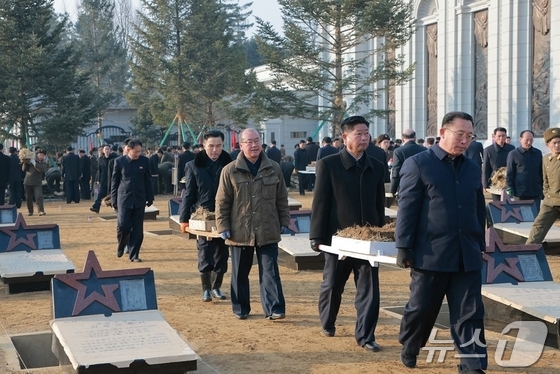
The same page reported that officials from the party’s Central Committee and the Ministry of Defense participated in a grass-planting event at the Heroes’ Cemetery, honoring veterans of overseas military operations. The attendance of senior party and military leaders, including Jo Yong-won and Kim Jae-ryong, emphasized the heroism of the veterans.
The article also spotlighted Gwaksan County, reflecting on the local guidance achievements of Kim Il Sung and Kim Jong Il while connecting them to Kim’s vision for local development.
Page 3 called for innovation in leadership methods among officials. The newspaper warned against dogmatic approaches, stating that mobilizing the ideological power and spirit of the masses is the essence of mature leadership, and urged the implementation of people-first principles. It also reported on practical training for national revolutionary history instructors and the opening of an exhibition showcasing equipment and propaganda materials related to the five-stage construction in the Hwasong district.
Page 4 highlighted the production achievements of the Sangwon Cement Joint Enterprise. The newspaper proclaimed that they challenged the goal of increasing production tenfold, surpassing existing limits, and detailed examples of self-reliance and technological innovation. They reported breakthroughs through self-made hydraulic loaders, shortened equipment overhaul periods, and enhanced preventive maintenance.
The same page featured a lengthy article on the life of Moon Myung-sil, a resident of Wonsan City, highlighting her activities before her passing. It showcased her efforts in caring for war veterans, supporting military units, and promoting afforestation, emphasizing civic patriotism.
Page 5 presented diversification of local industrial products and the expansion of raw material bases as major tasks. It introduced cases from the Jeongpyeong County food factory, which developed new products using local specialties like sweet potatoes and peanuts, as well as improvements in soap quality at the Sinyang County Daily Necessities Factory. The report urged the creation of promising raw material bases in cities and counties and called for increased production per unit area, identifying raw material supply as the key to normalizing local industry.
Page 6 reported on support for rural education. South Hwanghae Province dispatched teaching staff to rural schools to enhance teacher capabilities, while North Hwanghae Province expanded the establishment of multifunctional classrooms. North Hamgyong Province also conducted practical training for rural school teachers to encourage the implementation of the new educational curriculum.