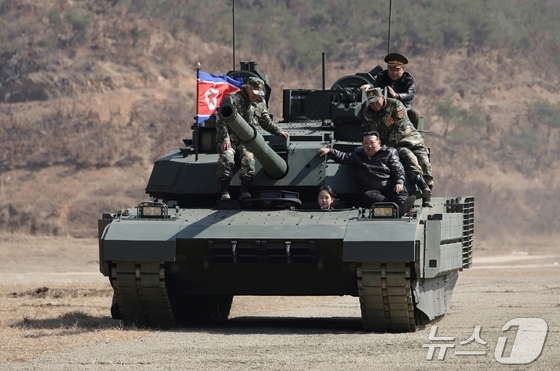
Kim Jong Un, Supreme Leader of North Korea, personally oversaw a combat exercise featuring the new Cheonma-20 tank, showcasing its advanced capabilities. Military analysts are particularly interested in North Korea’s claims of incorporating lessons from the Russia-Ukraine conflict, equipping the Cheonma-20 with drone countermeasures and an active protection system that automatically responds to anti-tank weapons.
On March 19, North Korea’s state-run newspaper Rodong Sinmun reported that Kim visited the Pyongyang No. 60 Training Base, under the command of the Korean People’s Army Capital Defense Corps, on March 19. There, he observed coordinated attack drills involving infantry and armored units.
The newspaper stated that the exercise aimed to hone the coordination and combat tactics of tactical units in striking, raiding, and seizing enemy anti-armor defense lines, followed by a combined tank and infantry assault to exploit the breakthrough. This suggests the drill was designed to simulate breaching the demilitarized zone (DMZ) and capturing key forward positions in a potential conflict with South Korea.
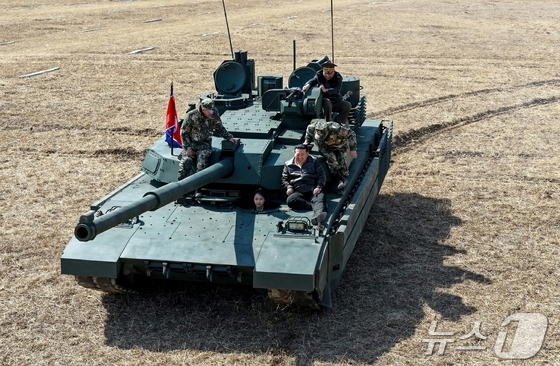
The exercise involved a company from the Cavalry Regiment, a key armored unit of the General Staff’s Reserve Operations Group, along with special operations forces. Notably, North Korea also deployed attack drones during the training.
Kim emphasized that the tanks used in the exercise were a new model developed over seven years, highlighting various performance aspects of the equipment.
He boasted that every component of the tank has been significantly enhanced, from its armor structure and power systems to its remote integrated automated fire control systems, electronic warfare suite, guided missiles, and active protection system. Kim claimed that there is no tank globally that can match its firepower, mobility, and especially its defensive capabilities.
This suggests that North Korea has made substantial improvements to both the offensive and defensive capabilities of its new tank, potentially increasing its battlefield survivability and lethality.
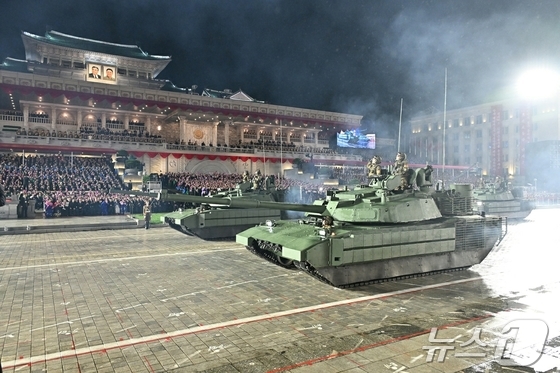
The Cheonma-20 was first unveiled as a prototype at the 2024 Defense Development Exhibition. It made its public debut in motion during the parade marking the 80th anniversary of the Workers’ Party in October last year. At the time, defense experts assessed that the Cheonma-20 symbolizes North Korea’s modernization of conventional forces and serves as a key element in its mechanized units, complementing its nuclear capabilities.
An active protection system automatically intercepts incoming anti-tank projectiles before they strike the vehicle. These systems typically employ two methods: hard kill, which physically destroys incoming threats with projectiles or fragments, and soft kill, which uses jamming or smoke screens to disrupt enemy targeting systems.
The active protection system mounted on the Cheonma-20 is believed to use a hard kill approach, similar to Israel’s Iron Fist system.
Shin Jong-woo, Secretary-General of the Korea Defense Security Forum, noted that the Cheonma-20 appears to be equipped with two anti-tank missiles to supplement its main gun, along with an active protection system and remote weapon station. He added that the claim of a 360-degree drone defense capability suggests they’ve incorporated lessons from the Ukraine conflict.
Shin continued that while South Korea is developing its own active protection system using blast-fragmentation technology for defense against anti-tank weapons, with a target completion date of late 2026, it may not be ready for integration into the fourth production run of K2 Black Panther tanks scheduled for 2029. He warned that the rapid modernization of North Korea’s conventional forces should not be underestimated.
Dr. Choi Gi-il, professor of Military Studies at Sangji University, assessed that North Korea appears to be leveraging significant technology transfers from Russia across various military domains, including tanks, naval vessels, and missiles. Choi explained that this demonstrates their ability to quickly apply combat lessons from Ukraine to real-world scenarios and enhance their technological capabilities. It also serves to showcase their strengthened relationship and solidarity with Russia.