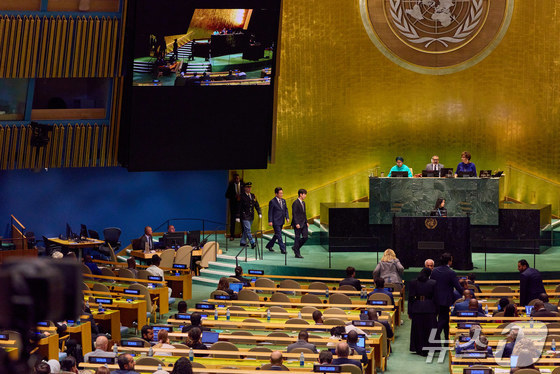
The government is reportedly considering not participating as a co-sponsor for the North Korean human rights resolution, which is set to be adopted at the 61st United Nations (UN) Human Rights Council later this month. This decision appears to be driven by a desire to minimize references to human rights issues, a topic North Korea is particularly sensitive about, in an effort to restore inter-Korean relations.
According to comprehensive reporting by News1, South Korea was not included in the list of early co-sponsors for the UN Human Rights Council’s North Korean human rights resolution, which closed for applications on March 18.
A government official stated that while they did not participate as early co-sponsors, there is still an opportunity to join as co-sponsors for about two weeks after the resolution is adopted between March 27 and 30. They explained that the government could still add its name to the list of co-sponsors either during the draft circulation period or even after the resolution is adopted.
However, by not participating as an early co-sponsor, South Korea would face limitations in actively negotiating the resolution’s wording with other countries. More importantly, the country’s name would not be listed at the top of the resolution after its adoption. In this case, the country’s name would only appear on the UN website displaying the resolution. For this reason, when the South Korean government has shown a clear willingness to participate in UN North Korean human rights resolutions in the past, it has typically joined as an early co-sponsor.
Last November, during the adoption of the North Korean human rights resolution by the UN General Assembly’s Third Committee, the South Korean government participated as an early co-sponsor. Given the Lee Jae Myung administration’s focus on improving relations with North Korea, this participation was somewhat unexpected. However, it was interpreted as a belief that South Korea should align with the international community on universal values like human rights.
The South Korean government’s participation in UN North Korean human rights resolutions has varied with different administrations. The UN Human Rights Council meets annually in the first half of the year, while the UN General Assembly convenes in the second half. Although the timing differs, the nature of the resolutions remains largely the same. South Korea participated as a co-sponsor for UN Human Rights Council and UN General Assembly resolutions from 2008 to 2018 but chose not to participate during the Moon Jae-in administration from 2019 to 2021, considering the potential impact on inter-Korean relations. The government returned to co-sponsorship with the inauguration of the Yoon Suk Yeol administration in 2022.
The Lee administration’s active engagement with the North Korean human rights resolution as recently as last November makes their current consideration to abstain until the last moment surprising. This shift likely results from further deterioration in inter-Korean relations.
The government has designated this year as the Year of Peaceful Coexistence on the Korean Peninsula and continues various efforts to resume dialogue and cooperation with North Korea. A notable example is when Minister of Unification Chung Dong-young held a briefing during the Lunar New Year holiday on February 18, expressing regret over the military’s drone operations against North Korea during the Yoon administration and a recent incident involving drones sent by civilians to North Korea. He also signaled a message to restore parts of the September 19 inter-Korean military agreement.
Despite these efforts, North Korea reinforced its stance as a hostile state towards South Korea during the 9th Congress of the Workers’ Party held last month, dismissing the current government’s conciliatory measures as a deception and a poor performance.
Regarding participation in the UN North Korean human rights resolution, the Ministry of Foreign Affairs stated that it is crucial for the government to improve the human rights of North Korean residents, and it will continue to collaborate with the international community to achieve this. They added that they’re reviewing the participation based on a comprehensive consideration of the government’s efforts for peaceful coexistence on the Korean Peninsula and the resolution’s wording.