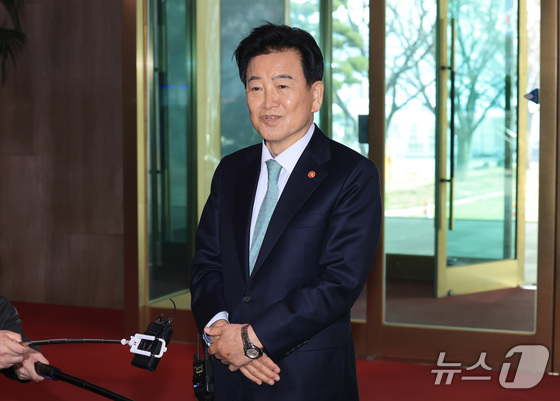
Unification Minister Chung Dong-young expressed his stance on the North Korean human rights resolution scheduled for adoption by the United Nations (UN) Human Rights Council at the end of this month. He stated that North Korea views this as a typical hostile policy, so there’s no compelling reason for them to push forward with it at the cost of potential backlash. It would be preferable not to participate as a co-sponsor.
On Thursday, during a press briefing at the Seoul Government Complex, Chung acknowledged that some within the government advocate for co-sponsorship. However, he emphasized the need to maintain consistency with one of the three principles of North Korea policy outlined by the Lee Jae Myung administration: refraining from any hostile actions.
These three principles, as highlighted by President Lee during last year’s Independence Day and this year’s March 1 Movement Day celebrations, encompass respecting North Korea’s regime, rejecting forced unification, and avoiding provocative actions.
Sources indicate that the government is considering not co-sponsoring the North Korean human rights resolution slated for adoption during the 61st UN Human Rights Council session from March 27 to 30. The administration didn’t add its name to the early co-sponsor list, which closed last week. However, a two-week window remains open for co-sponsorship following the resolution’s adoption, suggesting ongoing internal deliberations on participation.
The UN adopts North Korean human rights resolutions biannually: at the Human Rights Council in the first half of the year and at the UN General Assembly in the second half. Last November, during the adoption of the North Korean human rights resolution by the UN General Assembly’s Third Committee, the South Korean government actively participated as an early co-sponsor, engaging in discussions on the resolution’s wording.
Despite the government’s declaration of this year as the inaugural year of peaceful coexistence on the Korean Peninsula and its continued conciliatory approach toward North Korea, inter-Korean relations have deteriorated due to North Korea’s indifference. This has led to growing sentiment within the administration that mentions of the sensitive human rights issue should be minimized to facilitate relationship restoration.