Experts have proposed a radical shift in North Korea policy to bring Kim Jong Un, the General Secretary of the Workers’ Party of Korea, to the negotiating table for a U.S.-North Korea summit and other dialogues this year. This approach would involve deprioritizing policy goals related to denuclearization and unification, as well as suspending U.S.-South Korea joint military exercises and training.
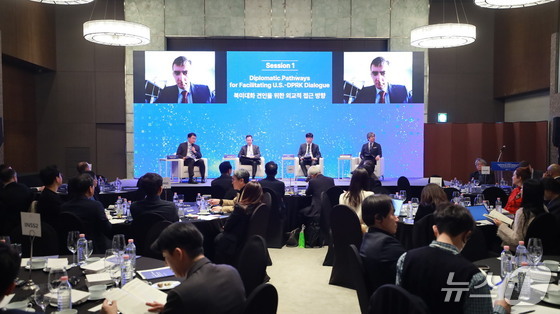
Frank Um, a non-resident fellow at the Stimson Center, spoke at a conference titled, Establishing a Peace Regime on the Korean Peninsula through North Korea-U.S. Dialogue, on Monday afternoon at the Plaza Hotel in Seoul. He noted that despite President Donald Trump’s multiple attempts to meet with Kim last year, a summit could potentially materialize in 2023, possibly during the U.S.-China summit in May or the Asia-Pacific Economic Cooperation (APEC) summit in November.
Um attributed the failure of North Korea-U.S. dialogue last year to the Lee Jae Myung administration’s contradictory approach of pursuing engagement with North Korea while maintaining a firm stance on denuclearization and unification – policies strongly opposed by Pyongyang. He suggested that the South Korean government should adopt a new strategy that places denuclearization as a lower priority and, if necessary, consider constitutional amendments regarding inter-Korean relations.
The researcher advocated for the active use of the Graduated Reciprocation in Tension-Reduction (GRIT) strategy. This approach involves offering preemptive goodwill gestures while being prepared to impose consequences if the other party fails to reciprocate. Notable examples include the suspension of the U.S.-South Korea Team Spirit exercises in 1992 and 1994, and the postponement of the 2018 Key Resolve (KR) and Foal Eagle (FE) exercises, which facilitated nuclear negotiations and dialogue on the Korean Peninsula.
Um outlined potential policy options, including: halting the deployment of U.S. strategic assets and joint military exercises, proposing sanctions relief and a declaration to end the Korean War, and lifting travel restrictions.
Kim Sung-bae, director of the National Security Strategy Institute, expressed regret over the postponement of President Trump’s visit to China due to the Iran conflict. However, he remained hopeful that when the U.S.-China summit eventually takes place, President Lee Jae-myung’s arms control approach could be included on the agenda.
Jeong Yeon-du, head of the Ministry of Foreign Affairs’ Strategic Information Office, emphasized that preventing the Korean Peninsula from becoming a new conflict zone is South Korea’s top diplomatic priority. He pledged to diligently prepare the groundwork for resuming North Korea-U.S. dialogue in coordination with the U.S., invoking the Korean proverb water droplets penetrate stone to underscore their persistent efforts.