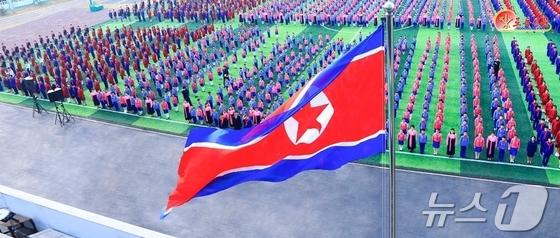
North Korea announced that all schools nationwide held opening ceremonies to commence the new academic year.
The Workers’ Party of Korea’s official newspaper, Rodong Sinmun, reported on its front page on Thursday that opening ceremonies were conducted on Wednesday at all educational institutions, from the capital Pyongyang to remote island villages. North Korea traditionally begins its new academic year every April.
The newspaper highlighted that all educators are committed to preparing students as the nation’s future workforce under the newly implemented Second Comprehensive 12-Year Compulsory Education Program starting this year.
On page 5, the paper also reported that an opening ceremony took place at the Korean Rehabilitation Center for Disabled Children. It emphasized the Party’s focus on rehabilitation and educational initiatives for children with disabilities.
Page 2 covered news of a plenary meeting of the Cabinet Party Committee, led by Premier Pak Thae -song, to discuss follow-up measures after last month’s first session of the 15th Supreme People’s Assembly. During this meeting, officials discussed and approved a resolution outlining implementation plans for the programmatic tasks presented by Kim Jong Un in his address to the Supreme People’s Assembly.
The resolution stressed the importance of strengthening leadership efforts to execute the new five-year plan and urged state economic guidance officials to remain dedicated to their duties in advancing the nation’s prosperity and the people’s well-being.
Page 3 featured news of a commendation awarded to the Chŏnson Youth Coal Mine for its exemplary performance in fulfilling last year’s economic plan. At the award ceremony, Party Central Committee Secretary Ju Chang-il urged that it must mark the first year of implementing the Party Congress decisions with outstanding coal production achievements.
Page 4 introduced the country’s top scientists and engineers for 2025. The newspaper lauded a research institute from Kim Il Sung University’s Department of Materials Science for developing processes to produce high-quality confidential products that meet the needs of various sectors of the national economy.
Page 6 contained criticisms of recent actions by the Japanese government to distort history. The newspaper stated that recently, the Japanese Ministry of Education, Culture, Sports, Science and Technology approved high school textbooks that deny the existence of coercion in crimes against humanity committed during colonial rule, such as military sexual slavery and forced labor. This reckless behavior is a calculated attempt to evade historical accountability and indoctrinate future generations with militaristic ideologies through distorted historical education. This is absolutely not a trivial matter and must be addressed.