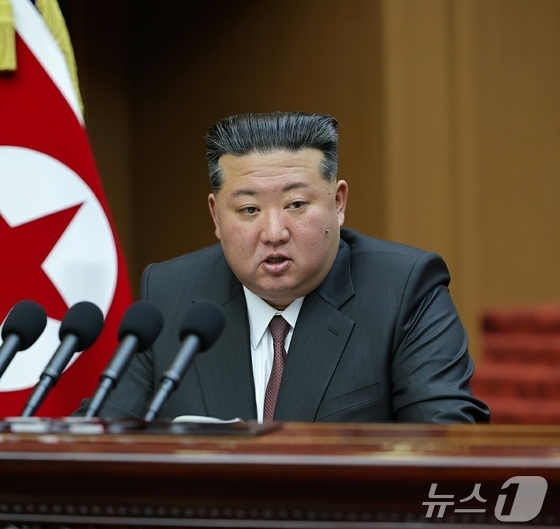
Kim Jong Un, the General Secretary of North Korea’s Workers’ Party, recently designated South Korea as the most hostile nation during his address at the Supreme People’s Assembly. Analysts on April 4 suggested that his deliberate omission of related constitutional amendments aligns with a strategy dubbed cold peace.
In response to North Korea’s new foreign strategy, some within the government argue that we should consider subtly rephrasing expressions related to national unity and reunification as it actively pursue inter-Korean cooperation initiatives.
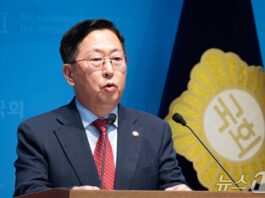
Kim Gyu-beom, a researcher at the National Security Strategy Institute, presented these views in a report titled, Analysis of the 1st Session of the 15th Supreme People’s Assembly: Kim Jong Un’s Third Foreign Strategy and Our Response Direction.
According to Kim, the North Korean leader confidently touted his achievements over the past five years in self-reliance (economy) and strengthening nuclear capabilities (defense). He reiterated that improving relations with the U.S. is impossible without abandoning the denuclearization goal and retracting hostile policies. Kim Jong Un also reaffirmed that dialogue with South Korea is off the table.
However, while officially labeling South Korea as the most hostile nation—implying that the two hostile nations policy has been enshrined in legislation or the constitution—Kim chose not to disclose the specifics of these amendments. The researcher interprets this as a calculated move to avoid unnecessary provocation while leaving room for potential diplomatic maneuvers.
Kim describes this approach as cold peace, noting that while North Korea shows no immediate interest in cooperation, it maintains strategic ambiguity to preserve flexibility.
If reports are accurate that Jang Geum-cheol, who previously oversaw North Korea’s South Korea strategy post-Hanoi summit, has become First Vice Minister of Foreign Affairs, it suggests Pyongyang is integrating its South Korea policy into broader diplomatic efforts while still prioritizing it.
Kim Jong Un’s emphasis on diplomatic tactics befitting North Korea’s elevated status signals a shift from isolation under sanctions towards more flexible and proactive international engagement.
In light of these changes, the researcher urges the government to seek common ground, suggesting that rephrasing narratives around national unity and reunification in more ambiguous terms could be a strategic move, given North Korea’s strong aversion to these concepts.
Reframing inter-Korean relations outside the context of ethnic ties is politically and socially challenging, Kim notes. Nevertheless, it should gradually initiate these discussions. Sometimes, adjusting the form can catalyze substantive progress.
He stresses the importance of clearly communicating to the public that such adjustments are tactical choices for managing tensions, not compromises on fundamental principles. Kim concludes that if North Korea responds positively and a mutual understanding develops, the current cold peace might eventually thaw.