A tariff policy overhaul by the United States is expected to increase the burden on Asian home appliance exports, including refrigerators, washing machines and air conditioners, as new rules apply duties based on metal content thresholds.
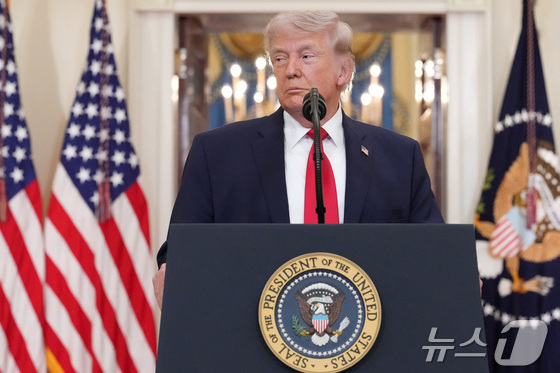
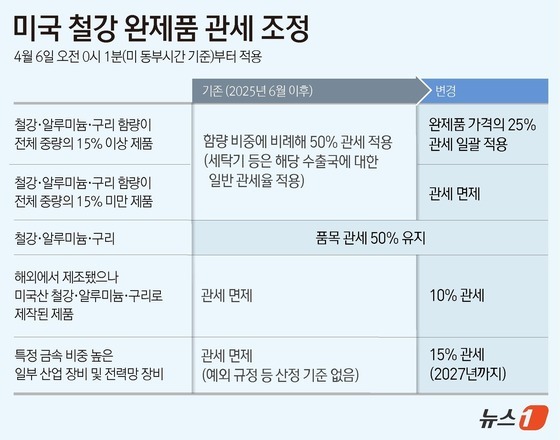
Under the revised system introduced by the administration of President Donald Trump, products containing 15% or more steel, aluminum or copper will face a fixed 25% tariff. Most appliances fall within a 30% to 60% metal content range, placing them under the new tariff framework. Previously, tariffs on derivative products were calculated proportionally based on metal content.
Starting April 6, tariffs will be applied to the total product price, a shift expected to significantly increase costs for high-value appliances. Meanwhile, some metal components are expected to see reduced tariff burdens. On April 3, the Trump administration announced the new tariff rules, specifying that derivative products with at least 15% metal content will be subject to a flat 25% tariff, while those below the threshold will be fully exempt.
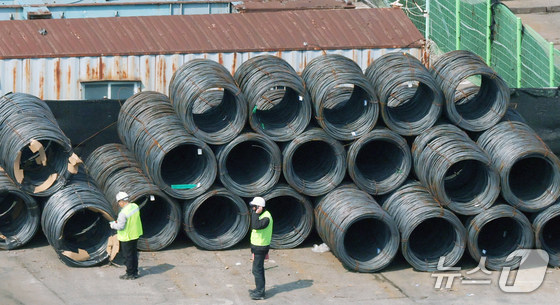
Unprocessed primary metal materials will continue to face the existing 50% tariff. The White House outlined applicable items under separate categories — Annex I-A (50%) and Annex I-B (25%) — to clarify the scope of the measures. Previously, the United States imposed tariffs of up to 50% on derivative products based on their metal content.
However, the method drew criticism for its complexity, as it required precise measurement of metal composition and value calculations for each product. The new system simplifies the process by applying tariffs to the entire product price rather than calculating based on metal content alone, resulting in higher costs for expensive finished goods with metal components exceeding the threshold.
Under the revised rules, refrigerators, washing machines, dryers and dishwashers will be subject to the 25% tariff.
While household air conditioners with higher plastic content may be exempt, industrial cooling equipment with higher metal content is expected to face the same tariff. Premium appliances — including side-by-side refrigerators with smart control panels, drum washing machines, system air conditioners and clothes dryers — are particularly likely to be affected.
The increased tariffs could lead to higher consumer prices, weakening price competitiveness for Asian manufacturers that have expanded their presence in the premium market in the United States. In addition, high-value machinery such as computer numerical control (CNC) equipment, excavators, forklifts and precision equipment used in semiconductor and display manufacturing may also be subject to the 25% tariff if their metal content exceeds 15%.
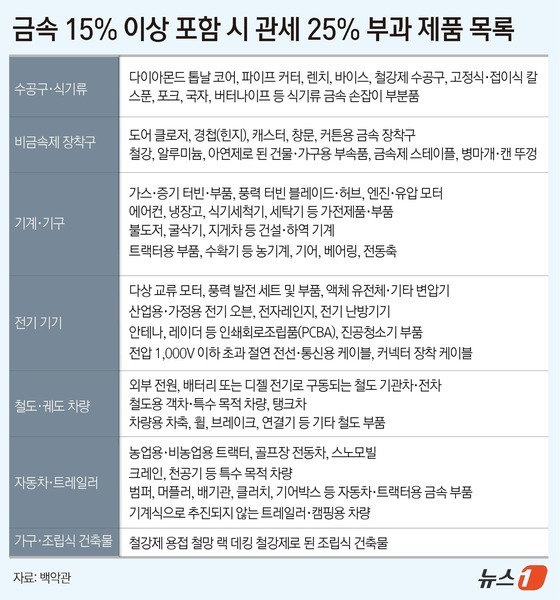
Some sectors may benefit from reduced or eliminated tariffs. Primary derivative components such as steel pipes and tubes, assembly brackets, construction metal frames, industrial bolts and nuts, and simple aluminum casings are expected to face lower tax burdens. Previously, these items were subject to tariffs approaching 50% due to their high metal content. Under the revised system, the tariff cap is fixed at 25%, reducing export costs.
Small consumer goods designed with less than 15% metal content — such as compact vacuum cleaners, electric toothbrushes and hair dryers — will be exempt from tariffs. In addition, key automotive components such as engine parts, steering systems and transmissions, which fall under separate tariff codes, as well as large transformers and power transmission cables granted temporary exemptions through 2027, will avoid the tariff increase. Experts said the policy change will create uneven impacts depending on the value structure of export products.
Lee Jae-yoon of the Korea Institute for Industrial Economics and Trade said the revised system simplifies previously complex calculations but creates differing outcomes across industries. He noted that low-priced components with high metal content could benefit, while high-value finished goods with relatively lower metal content may face disadvantages.
Chang Sang-sik, head of the International Trade and Commerce Institute, said that while the tariff rate for derivative products appears lower, the actual impact varies by product. “For finished goods such as appliances and machinery — key exports for Asia — where non-metal value is high, applying tariffs to the total product price could significantly increase the real burden,” he said.