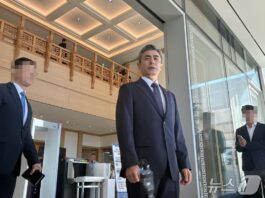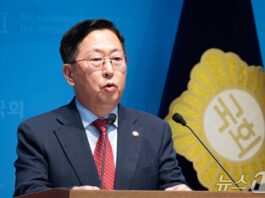
On Wednesday, Deputy Minister of Unification Kim Nam-jung emphasized the need for peaceful coexistence between North and South Korea, noting that the repercussions of the Middle East conflict are significantly impacting economies worldwide.
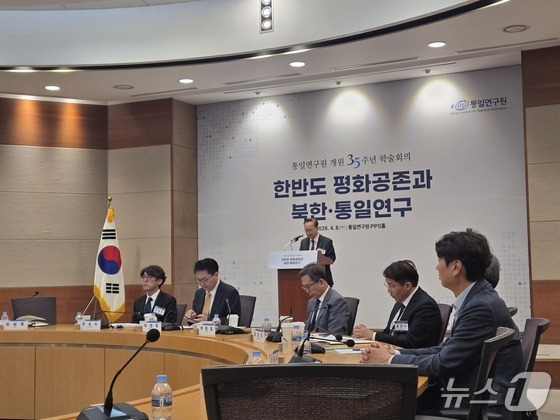
Speaking at the 35th anniversary academic conference of the Korea Institute for National Unification in Seoul, Kim stressed the increasing importance of inter-Korean peace. He affirmed the government’s commitment to gradually reducing tensions and building a foundation for peace, without rushing but maintaining steady progress.
Kim praised the Institute’s unwavering dedication to researching North Korean and unification issues over the past 35 years, despite fluctuations in inter-Korean relations. He described the Ministry of Unification and the Institute as steadfast partners in pursuing peace and unification on the Korean Peninsula, expressing hope for further strengthening of their collaborative efforts.
Acting Director Hyun Seung-soo of the Institute highlighted the critical nature of the current situation on the Korean Peninsula. He emphasized the urgent need for academic and policy discussions on improving inter-Korean relations and achieving peaceful coexistence, aiming to propose practical measures and policy recommendations to the government.
The conference featured expert recommendations calling for a new community framework capable of managing conflicts while respecting each side’s systems and unification perspectives, given the divergent concepts of peace and coexistence between North and South Korea.
Deputy Researcher Jeong Yoo-seok from the Institute’s Unification Policy Research Office argued that a policy of manageable coexistence focused on conflict control and clash prevention is the most realistic approach. He explained the fundamental differences in how the two Koreas perceive peace and coexistence.
Jeong elaborated on these differences, noting that South Korea views coexistence as a platform for expanding cooperation and institutional stability, while North Korea sees it as a limited concept centered on threat management. Given these disparities, he advocated for a policy of manageable coexistence as the most practical and achievable goal under current inter-Korean conditions.
Jeong emphasized that peaceful coexistence should be based on accepting differences rather than sharing identical goals. He suggested that when fundamental agreements are unattainable, a pragmatic approach of agreeing to disagree could help manage conflicts and maintain coexistence.
Addressing the realistic constraints in inter-Korean relations, Jeong noted North Korea’s policy shift towards denying ethnic homogeneity and the concept of unification, limiting the viability of defining inter-Korean relations as a special relationship.
He cautioned that if South Korea were to abandon its unification goals or alter its constitutional order to align with North Korea’s stance, it could lead to internal political conflicts and social divisions.
Jeong called for a new framework to counter North Korea’s hostile two-state theory. He proposed establishing a complex relationship that balances North Korea’s regime preservation concerns with South Korea’s cooperative orientation. This approach would reframe coexistence and unification as a continuous process rather than opposing concepts, considering mutual recognition of systems and potential for cooperation.
While acknowledging the peaceful coexistence policy as a practical strategy for conflict management and relationship stabilization, Jeong stressed that it should ultimately be designed as a pathway towards unification, cautioning against allowing peaceful coexistence to become a permanent end state.