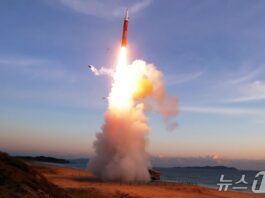
On Tuesday, Japanese Prime Minister Sanae Takaichi stated that it discussed North Korea’s issues, including its nuclear and missile concerns, and reaffirmed that Japan, South Korea, and the U.S. will closely coordinate the responses.
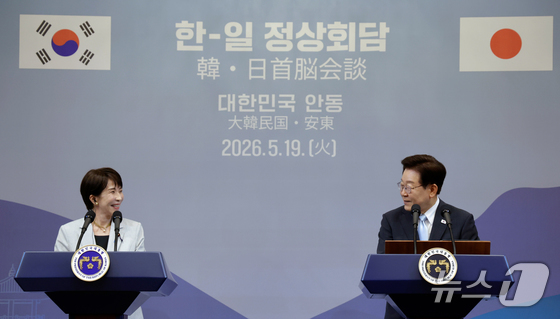
Takaichi made these remarks during a joint press conference following a Japan-South Korea summit held at a hotel in Andong, North Gyeongsang Province.
He expressed gratitude for President Lee Jae Myung’s support for the immediate resolution of the abduction issue.
Takaichi noted that in a time of global instability and turmoil, it’s crucial that the leaders of Japan and South Korea maintain close communication through shuttle diplomacy. The president and her had frank discussions not only about Japan-South Korea relations but also the broader Indo-Pacific situation, including developments in the Middle East.
She continued that it agreed to continue the efforts to promote regional stability, including ensuring free and safe navigation in the Strait of Hormuz. Given the current international climate, it recognizes the importance of both countries actively working to maintain and strengthen deterrence and response capabilities through the U.S.-Japan alliance, the South Korea-U.S. alliance, and strategic partnerships.
Takaichi emphasized that in light of recent global events, cooperation between Japan and South Korea on supply chains, particularly regarding critical minerals, is vital. They’ve agreed to actively pursue collaboration based on the memorandum signed in March.
He added that to realize a free and open Indo-Pacific and support regional supply chains, it’s essential for Japan and South Korea to work together to enhance each country’s autonomy and resilience.
Takaichi further stated, “The president and her welcome the agreement to initiate Japan-South Korea cooperation under the Power Asia initiative. This focuses on strengthening energy supply resilience and enhancing energy security through mutual exchanges of crude oil, petroleum products, and liquid natural gas (LNG), including swap transactions.
She also noted that they’ve agreed to continue discussions among relevant authorities to promote mutually beneficial cooperation in emerging fields like artificial intelligence (AI), as well as in the increasingly critical areas of economy and security.
Takaichi added that cross-border organized crime is a shared challenge for both nations. It welcomes the recent signing of a memorandum on cooperation to combat this issue.
She expressed approval of the recent inaugural vice-ministerial Japan-South Korea security dialogue, which stemmed from the January summit. Takaichi committed to steadily advancing bilateral cooperation.
Given the serious international situation, the president and her agreed on the importance of strategic cooperation, including Japan-South Korea and Japan-U.S. security collaborations. It welcomes the concrete cooperation already taking place, Takaichi stated.
Takaichi quipped that next time, President Lee, will you come to Japan? Shall it go to a hot spring?
She emphasized that they’ve confirmed our intention to strengthen trilateral cooperation in security and economic matters through closer information sharing and collaboration.
Takaichi also stated that today’s summit reinforces the commitment to maintaining close communication at all levels to promote regional and global peace and stability, and to elevate Japan-South Korea relations. It agreed to have frequent phone calls if any difficulties arise in the international relationships.
She concluded that next time, President Lee to visit Japan. Offering to go to a hot spring, or where shall it go? She’s excited to welcome President Lee to a beautiful place.