A recent analysis underscores the importance of establishing favorable pre-conditions and coordinating roles between South Korea and the U.S. regarding the potential dispatch of a special envoy to North Korea.
On Monday, the National Assembly’s Legislative Research Service released a report examining past cases of special envoys sent by previous administrations and outlining key considerations for future policy implementation.
The report evaluated the role of special envoys to North Korea as crucial negotiation tools that facilitate high-level communication during periods of strained inter-Korean relations. It noted that since the 1972 visit of Lee Hu-rak, then-Director of the Korean Central Intelligence Agency, to North Korea, special envoys have been dispatched during pivotal transitional periods, contributing significantly to inter-Korean summits and agreements.
Six administrations, including those of Park Chung-hee, Chun Doo-hwan, Roh Tae-woo, Kim Dae-jung, Roh Moo-hyun, and Moon Jae-in, have sent special envoys to North Korea. The report categorized these instances into two types: those necessitated by rapid shifts in international relations during the Cold War era, which made changes in inter-Korean relations inevitable, and those aimed at fostering peaceful relationships based on reconciliation and cooperation, while also seeking to improve U.S.-North Korea relations.
However, the report indicates that current conditions for sending a special envoy are challenging, given the state of inter-Korean relations. Since the breakdown of the 2019 Hanoi summit, North Korea has maintained a hardline stance against South Korea. Recent North Korean declarations labeling South Korea as a hostile state further diminish the prospects for improving relations.
The report highlighted that while special envoys have been vital policy instruments for enhancing inter-Korean relations and managing military tensions, they have also revealed limitations due to a lack of sustainability in outcomes. Some agreements effectively lost validity due to the deterioration of inter-Korean relations and ongoing issues surrounding North Korea’s nuclear program, demonstrating that policy effects have not endured in the long term.
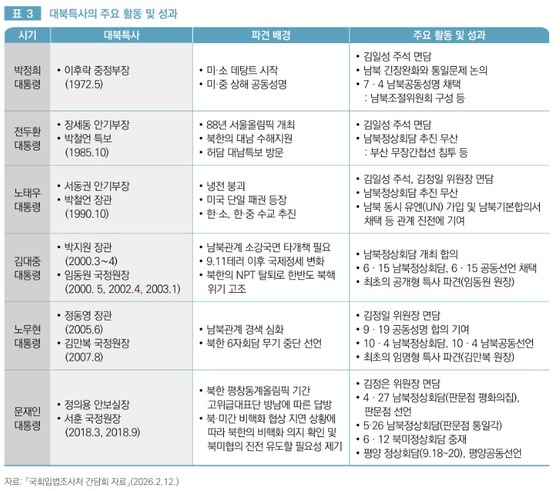
July 4 Joint Statement Scrapped Within a Year… Limits of Agreements Vulnerable to Unilateral North Korean Withdrawal
The 1972 July 4 Joint Statement began showing significant divergences during the October joint committee meeting convened to discuss its implementation. After three joint chair meetings and committee deliberations, North Korea effectively declared the cancellation of the joint statement on August 28, 1973, barely a year after its inception.
The report attributes this outcome to the absence of effective mechanisms to enforce inter-Korean agreements reached through special envoys, coupled with the lack of means to prevent North Korea’s unilateral breaches or provocations.
Consequently, the report emphasizes the necessity of creating favorable pre-conditions for future special envoy missions. It argues that without a shift in North Korea’s attitude and the establishment of a conducive dialogue atmosphere, achieving tangible results solely through envoy dispatches would be challenging.
The report also stresses the importance of considering a virtuous cycle where progress in U.S.-North Korea relations leads to improvements in inter-Korean relations. It suggests exploring strategic role-sharing with the U.S., such as supporting the advancement of a U.S. special envoy to ensure that positive developments in U.S.-North Korea relations translate into enhancements in inter-Korean relations.
Earlier this year, during the 9th Party Congress in February, North Korea signaled potential openness to dialogue with the U.S., stating that the future of U.S.-North Korea relations hinges on the American approach. If the U.S. respects the current status as outlined in the Constitution of the Democratic People’s Republic of Korea and abandons its hostile policies, it sees no reason why it cannot maintain cordial relations with the U.S.
Additionally, the report raises concerns about the transparency and institutional robustness of the special envoy system. It emphasizes the importance of securing public consensus through enhanced reporting procedures to the National Assembly.
In previous National Assemblies, special committees such as the Special Committee on the Development of Inter-Korean Relations were established to focus on enhancing inter-Korean relations. However, no such special committees have been formed since the 21st National Assembly.
The report also suggests that the provisions outlined in the Inter-Korean Relations Development Act require enhancement. It proposes that when the President appoints a special envoy to North Korea, the Minister of Unification should promptly notify the relevant standing committee. Furthermore, it recommends that the outcomes of the special envoy’s mission be reported to the standing committee on inter-Korean relations and North Korea policy, with provisions for non-public sessions if necessary.
In conclusion, the report asserts that reinforcing the system in this manner would bolster the credibility of North Korea policy and foster greater public consensus and support for these diplomatic initiatives.