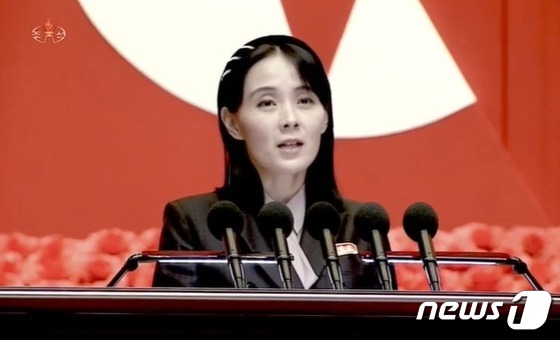
North Korea harshly rebuked the South Korean government’s assessment that Kim Yo-jong’s statement, released on Monday, was a response to President Lee Jae Myung’s expression of regret over the drone incident, calling it a wishful interpretation by stupid fools.
Notably, they issued an unusual late-night statement directed at South Korea, using crude language such as calling them mangy dogs. Analysis on Wednesday suggests this was intended to quickly prevent Kim’s statement from being interpreted as a signal for improving inter-Korean relations, diverging from their original intent. Some speculate that there may have been internal criticism in North Korea regarding the polite tone of Kim’s statement.
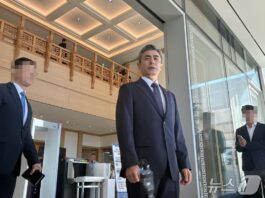
Jang Kum-chol, First Vice Minister of Foreign Affairs and Director of the 10th Department, released a statement around 11:00 p.m. (Korean time) on Tuesady titled, The identity of South Korea as the most hostile enemy state cannot change, criticizing various South Korean interpretations of Kim’s statement, including those from the presidential office, as truly absurd.
Director Jang argued that if the South Korean side interprets their swift response as an unusually friendly reaction or a quick mutual confirmation between leaders, it would be recorded as another wishful interpretation by stupid fools that surprises the world.
Jang’s statement targeted the situation that unfolded after President Lee expressed regret over the civilian drone incursion into North Korea during a cabinet meeting on Monday morning, and Kim’s subsequent statement that evening praising it as very fortunate and a wise move for their own sake, adding that “our supreme leader (Kim Jong Un) sees this as showing an honest and broad-minded attitude.
When Kim refrained from using harsh language and Kim Jong Un’s generous evaluation of President Lee was revealed, the presidential office and the Ministry of Unification stated that it was a meaningful progress towards peaceful coexistence on the Korean Peninsula, as the intentions of both Korean leaders were quickly confirmed and communicated, raising the possibility of changes in inter-Korean relations.
Jang Rushes to Clarify Misinterpreted Message… Was There Criticism of Kim’s Statement?

In his statement released suddenly the previous night, Director Jang appeared to suggest that his reason for stepping forward was to correct the South Korean government’s misinterpretation, saying that since they are slow to understand, he wants to enlighten them about the true meaning of the statement (by Kim) that he reads.
He explained that the core of Kim’s statement was a clear warning, and his interpretation of its underlying message was: If you (South Korea) want to live safely, you should know how to honestly admit your own faults like this. Among the group of shameless ones, there was someone who was decently honest…? If you want to live safely, prevent the recurrence (of the drone incident). He added that this was the basic outline of the statement as he read it.
The intention of Kim’s statement was merely to accept President Lee’s acknowledgment of responsibility for the drone incident and secure a promise to prevent its recurrence, without any further meaning. However, it can be interpreted that President Lee was evaluated as a decent person to some extent.
However, Director Jang’s statement was presented in a format that seemed like an individual expressing their personal opinion. It’s notable that despite Jang not having decision-making authority on inter-Korean matters, expressions like “as I read it” were included, as well as incomplete sentences like “There was someone who was decently honest…?” Typically, in official statements, first-person subjects like “I” have only been used by Kim, who has exceptional power as the speaker for General Secretary Kim Jong Un.
Furthermore, while being the subject of the statement, Director Jang focused more on conveying Kim’s true intentions rather than emphasizing the authorities’ position. For example, he relayed that Kim, in a conversation with him, criticized South Korea’s participation as a co-sponsor of the United Nations (UN) Human Rights Council’s resolution on North Korean human rights on March 30, calling them mangy dogs that bark mindlessly following the neighborhood dogs.
Some interpret that the unusual nature of this statement may reflect a kind of embarrassment within the Workers’ Party about how the supreme leadership’s message was perceived externally, different from expectations. They speculate that feeling burdened by Kim’s statement being seen as North Korea’s calculated intention for a transformation in inter-Korean relations, they belatedly emphasized Kim’s use of the term dogs for South Korea, attempting to cover up Kim’s mistake.
A notable characteristic of Director Jang’s statement, despite being aimed at South Korea, is that it was released at the unusual late-night hour (11:00 p.m.) when North Korea typically times its announcements to coincide with the start of the workday in Washington D.C. This could indicate that Jang’s statement was issued urgently through quick decision-making, or that there were concerns about the U.S. indiscriminately accepting the South Korean government’s judgment and making active gestures towards North Korea.
Who is Jang, Who Returned to Inter-Korean Affairs?… Practical Leader of Aggressive South Korea Policy 7 Years Ago
Meanwhile, analysis suggests that Kim not directly refuting the South Korean government’s judgment, but having her subordinate Director Jang appear instead, might be a strategy to broaden the leadership’s room for maneuver by separating their roles. This could mean that, with potential changes in foreign strategy in mind, the leadership would maintain a restrained stance while more explicit messages are delivered at the working level.
Director Jang, known to have been involved in past inter-Korean exchange projects, was appointed as the head of the United Front Department, the Workers’ Party’s department for South Korean affairs, when the situation deteriorated after the collapse of the Hanoi North Korea-U.S. summit in 2019. Apart from briefly appearing during the trilateral meeting between then-President Donald Trump, General Secretary Kim Jong Un, and then-President Moon Jae-in on June 30 of the same year, he has not had many public activities.
His profile is notable for being the practical leader during aggressive South Korea operations, such as accompanying General Secretary Kim when he visited the Mount Kumgang tourist area in October 2019 and ordered to remove the shabby South Korean facilities, and issuing a statement related to the demolition of the inter-Korean liaison office in Kaesong in June 2020.
Director Jang, who had disappeared from the power structure without clear reason, was re-elected as a member of the Party Central Committee at the 9th Party Congress in February, raising the possibility of his return to inter-Korean affairs. The National Intelligence Service recently identified him as concurrently serving as the First Vice Minister of Foreign Affairs and Director of the Party’s 10th Department (formerly the United Front Department), which North Korea officially confirmed through yesterday’s statement.
Through Director Jang’s statement, it was officially confirmed that the 10th Department of the Party, the new name for the United Front Department which was downsized after North Korea’s declaration of two Koreas, has been incorporated into the Foreign Ministry under the cabinet from being a specialized department of the Workers’ Party. This can be seen as North Korea completing institutional reforms to treat inter-Korean relations as state-to-state relations.
However, the fact that Director Jang shared personal opinions with Kim, the director of the Party’s General Affairs Department, who could be considered his direct superior in the organizational structure, rather than Foreign Minister Choe Son-hui, and conveyed her intentions through a statement, confirms that North Korea still maintains inter-Korean affairs as a matter for the supreme leadership to decide, according to some interpretations.