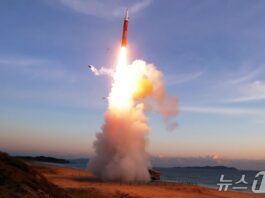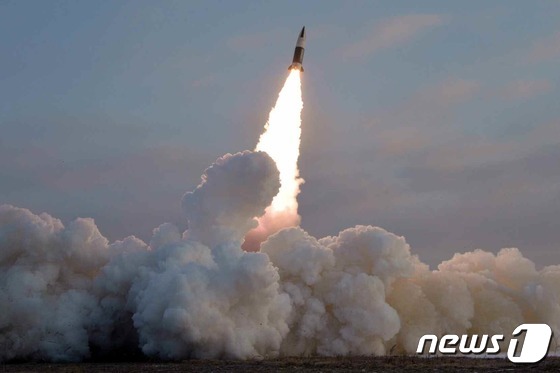
North Korea claims to have tested a short-range ballistic missile (SRBM) equipped with cluster munitions, signaling a strategy of concentrated strikes and total destruction aimed at the entire Korean Peninsula in case of conflict.
The Korean Central News Agency reported on Thursday that research institutes under North Korea’s Missile Command conducted critical weapon system tests from Monday to Wednesday. These tests verified the performance of the SRBM known as Hwasong-11 (which North Korea refers to as a tactical ballistic missile) fitted with a cluster warhead.
Pyongyang asserts that this warhead can devastate an area of approximately 6.5 to 7 hectares, or about 70,000 square meters. This is roughly equivalent to the size of ten soccer fields combined.
The cluster warhead, as described by the agency, contains multiple submunitions within a single warhead. Upon detonation, these submunitions scatter, allowing for a wide-area strike. This design can potentially inflict more extensive damage than conventional high-explosive munitions.
This test evaluated a new warhead for the Hwasong-11 series, a ground-to-ground SRBM often dubbed the North Korean Iskander (designated KN-23 by South Korea and the U.S.). It marks North Korea’s first public revelation of cluster munitions since November 2022, when it conducted a test launch of a tactical ballistic missile with cluster munitions in response to the U.S.-South Korea joint air exercise Vigilant Storm.
Although North Korea withheld photos of the recent test launch, limiting detailed assessment of its specifications and performance, analysts suggest that the introduction of cluster munitions represents a significant shift in missile operational concepts. Pyongyang has been developing a strategy that focuses on delivering concentrated strikes against South Korea through various SRBMs, including the Hwasong series and upgraded super-large multiple rocket launchers, while simultaneously deterring the U.S. with its strategic nuclear capabilities.
While conventional missiles are designed to hit specific targets, cluster munitions are intended for broad and indiscriminate Target. This suggests that North Korea aims to rapidly incapacitate South Korea’s military and industrial infrastructure in a single, early attack, further concretizing its annihilation strategy.
South Korea’s Joint Chiefs of Staff stated that they’re conducting precise analysis on the exact specifications and are closely monitoring North Korea’s missile launch trends, sharing relevant information with the U.S. and Japan. However, they refrained from specific evaluations regarding the performance of the cluster munitions announced by North Korea, noting that they’re closely observing North Korea’s weapon development trends. There’s also speculation that North Korea’s claims may be exaggerated.
Cluster munitions are classified as inhumane weapons due to their potential for indiscriminate civilian casualties. However, major countries, including South Korea, officially maintain them citing security concerns. The South Korean military confirmed its operational capability by conducting live-fire training with cluster munitions in May last year.
Additionally, North Korea reported conducting tests on various weapon systems, including maximum operational load tests of engines using low-cost materials, electromagnetic weapon system tests, and trials for dispersing carbon fiber munitions. Among these, carbon fiber munitions, known as blackout bombs, are designed to disable adversaries’ power grids. When the warhead detonates mid-air, it releases nickel and carbon fibers that adhere to power lines or transformers, disrupting the electrical system.
Shin Jong-woo, Secretary General of the Korea Defense Security Forum, analyzed that North Korea’s disclosure of these various weapon systems appears to showcase its asymmetric warfare capabilities and effectiveness, as demonstrated in recent U.S.-Iran conflicts.
He noted that there have been instances where Iran’s Qadr ballistic missiles penetrated air defense systems using cluster munitions, adding that North Korea seems to be combining various weapon systems, including carbon fiber munitions, to potentially cripple power networks in a conflict. He also suggested that the engine tests using low-cost materials could indicate an intention to mass-produce missiles.