

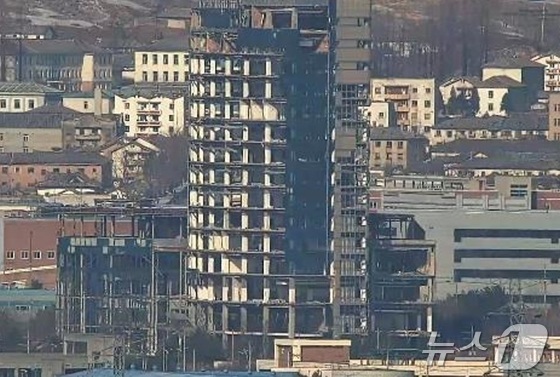
A North Korean official document has been discovered that refers to the Kaesong area as the southern border gateway and the frontline outpost in the struggle against the enemy.
This revelation, found in the December 2025 issue of the Workers’ Party of Korea’s journal Labourer, has sparked speculation about North Korea’s intentions to potentially demolish the Kaesong Industrial Complex and convert the area into a military base. The article, authored by an unidentified individual believed to be from the Kaesong City Security Bureau, is titled, Let’s Become Vanguard Fighters with a Steadfast View of the Main Enemy and Anti-Enemy Consciousness.
The author emphasizes that the Kaesong City Security Bureau is intensively conducting ideological education to instill a sense of mission in social security personnel and soldiers, reminding them that they are guarding the southern border gateway and the frontline outpost in the struggle against the enemy. The bureau is also deeply instilling the party’s military-first ideology and policy, encouraging them to diligently study military affairs, firmly grasp the revolutionary gun, and maintain a state of constant tension and mobilization.
While the exact role of the Kaesong City Security Bureau remains unclear, the military terminology used, such as southern border gateway and frontline outpost, suggests that North Korea views the Kaesong area as a strategically important military location. This shift in perception from a hub of inter-Korean cooperation to a military stronghold aligns with North Korea’s intensified stance against South Korea under its two-state policy.
The author further emphasizes that the U.S., South Korea, and Japan are considered primary enemies due to their long-standing hostile actions against North Korea. Despite changes in leadership, these countries’ aggressive ambitions and hostility towards North Korea have remained unchanged.
The article calls for strengthening anti-imperialist and anti-American education, as well as class consciousness, to ensure that all people, soldiers, and youth clearly understand who the main enemies are and maintain a resolute determination to fight and achieve victory against them.
Additionally, the author stresses the importance of maintaining constant combat readiness to protect sovereignty, territorial integrity, and the safety of the people from military threats, invasions, and attacks by hostile forces. The current situation, according to the article, demands that the entire population be prepared to engage in combat at any time and decisively defeat the enemy, calling for a united effort to strengthen national defense capabilities.
Kaesong: A Military Strongpoint Just 50km from Seoul, with Flat Terrain Extending to Pyongyang
The Social Security Forces, while normally under the command of the Ministry of Social Security during peacetime, are believed to function as a direct military arm of the State Affairs Commission under Kim Jong Un’s control during emergencies. This organization is thought to be more heavily armed than typical police forces, comparable to U.S. National Guard units in terms of combat capability.
The proximity of Kaesong to Seoul, a mere 50km (about 31 miles) away, means that North Korean long-range artillery and multiple rocket launchers positioned near Kaesong could immediately threaten the entire Seoul metropolitan area. The flat terrain from Kaesong through Paju and Munsan to Seoul provides an ideal route for rapid deployment of large armored units and troops, making it a likely primary invasion route in the event of war. Northward, a highway connects Kaesong directly to Pyongyang, further underlining its strategic importance.
Geographically, Kaesong’s strategic value is multifaceted. Its location near the Imjin River estuary and the West Sea allows for potential flanking maneuvers via sea routes and poses a threat to critical national facilities such as Incheon International Airport.
The military-strategic importance of Kaesong was acknowledged even during periods of active peaceful dialogue between North and South Korea, such as around the time of the June 2000 inter-Korean summit. Former South Korean President Kim Dae-jung, recognizing Kaesong’s proximity to Seoul and its military significance, proposed to North Korean leader Kim Jong Il that military facilities in Kaesong be relocated to make way for an industrial complex.
While North Korean military officials strongly opposed this idea, viewing it as opening a pathway for a southern invasion, Kim Jong Il reportedly overruled their objections and ordered the relocation of elite units, including the 6th Division, from Kaesong to rear areas.
Former South Korean Unification Minister Lim Dong-won, in his memoir Peacemaker, assessed that the Kaesong region, as North Korea’s frontline stronghold, was an area that could never be opened from a military-strategic perspective.
North Korean Military’s Resistance to Kyeongui Line and Kaesong Industrial Complex; Threats of Military Redeployment Six Years Ago
With the establishment of the Kaesong Industrial Complex, North Korea relocated its 6th and 64th Divisions and the 62nd Artillery Brigade, which had been stationed near Kaesong and Panmunjom, to rear areas.
However, whenever the operation of the Kaesong Industrial Complex faced disruptions, North Korea used the threat of militarizing Kaesong as a bargaining chip or to issue unilateral threats. This behavior suggests that the North Korean military never fully abandoned its claim on Kaesong.
In April 2013, when the complex’s operations were suspended due to North Korea’s nuclear tests and the South Korean government’s subsequent reactions, North Korea’s Central Special Zone Development Guidance Bureau hinted at the possibility of military use, stating that if the complex were to be closed, they would reclaim the vast area of the Kaesong Industrial Zone as a military zone, opening a clear path for a southward advance and creating more favorable conditions for the great war of national unification.
Furthermore, in June 2020, the day after North Korea demolished the inter-Korean liaison office within the Kaesong Industrial Complex, the North Korean General Staff Department announced plans to deploy regiment-level units and artillery units to the Mount Kumgang tourist area and the Kaesong Industrial Zone.
At that time, the General Staff Department, through the Korean Central News Agency, stated that they were considering plans to advance troops into the Demilitarized Zone (DMZ) and would redeploy guard posts (GPs) to strengthen frontline surveillance.