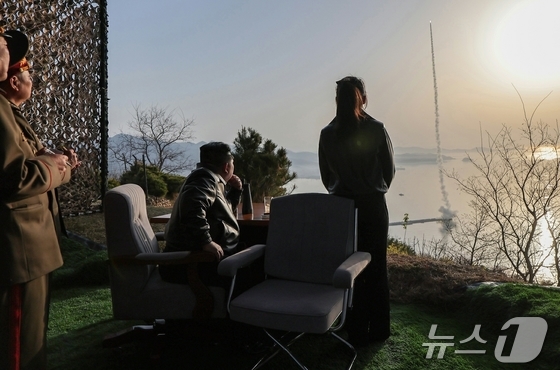
North Korea conducted a test launch of its upgraded tactical ballistic missile, the Hwasong-11a, to verify the warhead’s effectiveness. Kim Jong Un, General Secretary of the Workers’ Party, observed the test alongside his daughter, Ju-ae, expressing satisfaction with the results.
On Monday, North Korea’s state-run newspaper Rodong Sinmun reported that the North Korea’s Missile Bureau carried out a test launch on April 19 to evaluate the warhead’s effectiveness of the upgraded surface-to-surface tactical ballistic missile Hwasong-11a.
General Secretary Kim attended the test with Kim Jong-sik, a member of the party’s Central Military Commission, Chang Chang-ha, director of the Missile Bureau, and other military commanders.
Pyongyang stated that the test aimed to confirm the characteristics and effectiveness of both dispersion and fragmentation mine warheads. They claimed to have launched five tactical ballistic missiles at a target island 136 kilometers (about 84.5 miles) away, striking an area of 12.5 to 13 hectares with high density.
The impacted area of 12.5 to 13 hectares is equivalent to approximately 38,000 to 40,000 pyeong, or about 17 to 18 soccer fields.
Kim stated that developing various dispersion warheads would more efficiently meet military operational needs, emphasizing that enhanced high-density suppression strike capabilities on specific target areas hold significant military implications.
He added that the results validate five years of missile warhead research and called for continued advancements in defense science technology.
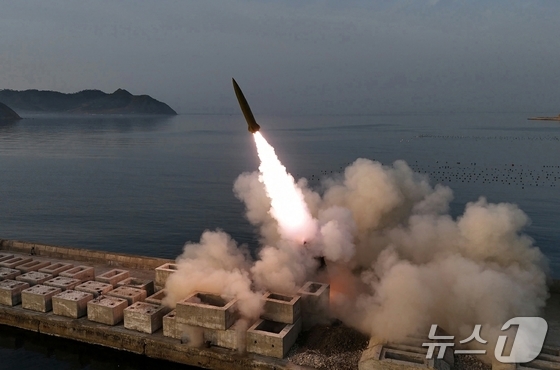
The dispersion warhead revealed by North Korea is assessed to be a type of cluster munition, which disperses multiple submunitions to simultaneously strike a wide area. This allows a single missile to release several small bombs, effectively targeting areas with concentrated troops and equipment.
The tested fragmentation mine warhead is believed to combine immediate lethality through scattered metal fragments upon detonation with mine-like characteristics, making the targeted area difficult to access due to residual debris.
Cluster munitions have long been controversial internationally due to the risk of unexploded ordnance causing civilian casualties. The Convention on Cluster Munitions (CCM) prohibits their use, but North Korea is not a signatory to this agreement.
Notably, photos released by North Korea show the missile being launched towards the sea, with a maritime target.
Given the wide dispersal pattern of cluster munitions, land-based tests pose a high risk of uncontrolled damage. It appears that North Korea chose a maritime test to minimize potential collateral damage.
This test aligns with North Korea’s recent emphasis on enhancing its tactical nuclear capabilities and diversifying its short-range strike options.
The South Korean Joint Chiefs of Staff reported that North Korea launched several short-range ballistic missiles into the East Sea from the Sinpo area the previous day. They stated that the detected missiles flew approximately 140 kilometers (about 87 miles), and that the U.S. and South Korea are conducting a detailed analysis of their specific characteristics.