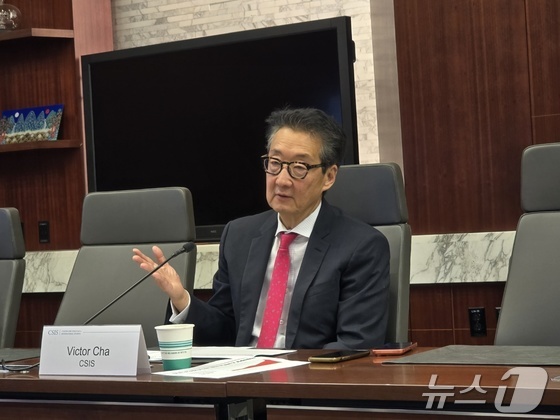
On Tuesday, Victor Cha, the Korea Chair at the Center for Strategic and International Studies (CSIS) in Washington, D.C., stated that North Korea’s denuclearization is not an achievable short-term goal and emphasized the need to re-evaluate the strategy of cold peace with North Korea.
Cha made these remarks during a briefing for South Korean correspondents at the CSIS office in Washington, D.C. He assessed that the denuclearization strategies of successive U.S. administrations over the past 30 years, initiated after the North Korean nuclear crisis in the mid-1990s, have failed.
He pointed out that U.S. policy toward North Korea has consistently revolved around the concept of CVID—Complete, Verifiable, Irreversible Dismantlement—in any negotiations with North Korea.
Cha continued that the U.S. has maintained that anything is possible with denuclearization, but without it, nothing is possible. The primary tool has been sanctions. The goal is denuclearization, and the means are sanctions, which are now considered a failure.
Cha argued that if it hadn’t failed, North Korea would have implemented the 1994 Geneva Accords or the denuclearization measures from the Six-Party Talks (2003-2009). All commitments have faltered at the reporting stage.
He acknowledged that while denuclearization is crucial and should always be a goal, realistically, negotiations shouldn’t be limited to just that.
Cha noted that North Korea is estimated to possess 50 nuclear weapons and has enough fissile material to produce 50 more. The likelihood of achieving denuclearization in the short term is slim.
He remarked that many in Washington recognize that the past efforts have been ineffective. However, people are reluctant to admit failure because they’re uncertain about the next steps.
Previously, Cha proposed the concept of cold peace in a recent Foreign Affairs article.
He summarized the strategy by stating that its aim is to build peace between the U.S. and North Korea. The U.S. needs to shift its strategic focus from dismantling North Korea’s nuclear weapons to achieving immediate objectives that better protect the U.S. from those weapons.
Cha identified four key elements of cold peace: protecting the U.S. mainland, reducing the number of adversaries the U.S. must confront, lowering the risk of nuclear first use in Asia, and weakening the North Korea-Russia relationship.
He cautioned that North Korea is accumulating nuclear warheads and delivery systems that can overwhelm the U.S. missile defense system. Focusing solely on denuclearization while North Korea enhances its missile capabilities is not an effective strategy for defending the U.S. mainland.
He added that it needs to discuss arms control agreements that include limiting long-range Intercontinental Ballistic Missile (ICBM) deployment, capping warhead payloads, halting additional fissile material production, and banning nuclear tests.
Cha pointed out that the U.S. currently faces multiple adversaries, including China, Russia, Iran, and North Korea. He stated that from a national security perspective, having too many adversaries is problematic. North Korea is the only one the U.S. isn’t currently in direct or indirect conflict with. One goal of cold peace is to reduce the number of adversaries we must deal with.
He addressed the growing nuclear threat in Asia, stating that during the Ukraine war, Russia declared its right to use nuclear weapons first, and North Korea soon after adopted a nuclear first-use doctrine. While China claims to adhere to a no-first-use policy, it’s rapidly increasing its nuclear arsenal to at least 1,000 warheads.
He further explained that countries like Russia, North Korea, and China have the potential to use nuclear weapons first, either in response to conventional conflicts or as a preemptive measure. North Korea has delegated nuclear strike authority to lower command levels to prepare for potential decapitation strikes.
He remarked that it lacks mechanisms to manage such crises, as attempts to establish them would be seen as recognizing North Korea as a nuclear power.
He added that in a nuclear crisis with North Korea, we might have only about 20 minutes to respond. Channels like the New York or Panmunjom channels wouldn’t be useful in such situations.
Cha assessed the growing North Korea-Russia relationship as very dangerous. He noted that North Korea is receiving significant support from Russia, which is one reason it shows little interest in dialogue with the U.S.
He expressed concern that if Russia provides advanced military technology to North Korea, it would threaten U.S. mainland security and increase the potential for miscalculation on the Korean Peninsula.
Cha also mentioned the differences in China’s and Russia’s influence over North Korea. He stated that China exerts more stable influence over North Korea’s actions. While China opposes North Korea’s seventh nuclear test, Russia seems indifferent.
During the briefing, Cha reported that figures from Donald Trump’s potential second administration are reluctant to discuss North Korea policy.
He noted that Trump administration officials willingly discuss Iran, Ukraine, Russia, and China, but they avoid North Korea because they know the President himself handles that issue.
Cha elaborated that they want to avoid saying anything the President might disagree with. They understand that only the President can speak about North Korea.
He also shared reactions from conservatives, statin that some conservatives who read this article told that it can’t disagree with that. Even those who’ve always emphasized sanctions said they can’t disagree. The progressive camp, naturally, favors this approach.
However, Cha stressed that the cold peace strategy should not be seen as undermining alliances or making concessions to North Korea.
He clarified that this strategy doesn’t involve selling out the allies’ interests. It must be combined with programs that significantly enhance missile defense and deterrence for the U.S., South Korea, and Japan.
Born in New York in 1961, Cha also serves as a Georgetown University professor and previously held the position of Director for Korea on the National Security Council during the George W. Bush administration from 2004 to 2007.
He is classified as a conservative and was once nominated as U.S. Ambassador to South Korea during Trump’s first term, though that nomination was later withdrawn.
Cha stated that he’s known as a hardliner on North Korea, but considers himself a pragmatist. He’s convinced it can’t succeed by continuing down the path it has taken so far.