

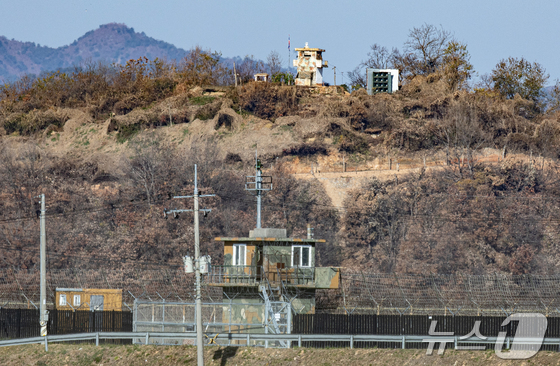
As North Korea moves to redefine the Military Demarcation Line (MDL) as a “southern border line,” signaling efforts to undermine the armistice framework, analysts say the shift should be viewed not only as a threat but also as an opportunity to explore a new model of coexistence.
Kim Won-sik, a researcher at the Institute for National Security Strategy, said in a report released May 1 that North Korea is pursuing a strategy to effectively solidify the MDL as a permanent border based on its “two hostile states” doctrine.
The MDL was established under the 1953 armistice agreement as a temporary military control line. However, North Korea has increasingly treated it as a de facto permanent border, accompanied by physical measures such as cutting off cross-border rail links and building barriers.
In recent years, Pyongyang has taken steps to reframe inter-Korean relations as those between two hostile states. In January 2024, leader Kim Jong Un defined South Korea as an “enemy state” during a Supreme People’s Assembly session and instructed revisions to constitutional provisions related to unification, signaling a shift away from reunification as a policy goal.
In October 2024, North Korea demolished sections of cross-border rail lines and framed the move as part of its “southern border” policy. Analysts say such actions could weaken the armistice framework and allow future clashes near the border to be framed as responses to territorial violations.
Kim said the shift goes beyond a change in terminology and reflects an effort to institutionalize both legal and physical separation between the two Koreas, potentially increasing structural military tensions.
Issues previously managed as armistice violations could instead be treated as territorial incursions, raising the risk that accidental clashes escalate into broader conflicts. Concerns are particularly high around the Northern Limit Line (NLL) in the Yellow Sea, where competing maritime claims could heighten tensions.
However, Kim noted that the situation could also present an opportunity to establish a new coexistence framework. North Korea’s “two states” approach may be aimed at gaining international recognition, potentially opening room for negotiations on new rules governing inter-Korean relations.
He emphasized the need for a new agreement framework to reduce perception gaps and prevent conflict, pointing to the current government’s proposal for a “Basic Agreement” between the two Koreas as a step in that direction. He added that approaches centered solely on ethnic unity are no longer sufficient to manage the current conflict structure.
Kim also suggested that future efforts to reset inter-Korean relations will inevitably involve debates over recognition of North Korea’s statehood and border issues. Domestically, he said, South Korea will need consensus on response principles within the bounds of its constitutional framework, while externally preparing more sophisticated negotiation strategies.
He pointed to the Basic Treaty between East and West Germany as a relevant precedent. At the time, both sides compromised on the term “existing boundary” after disputes over border terminology, offering lessons for managing similar issues on the Korean Peninsula.
North Korea’s push for a “southern border line,” the report concluded, highlights both the fragility of the armistice system and the growing need to establish new rules for coexistence between the two Koreas.