

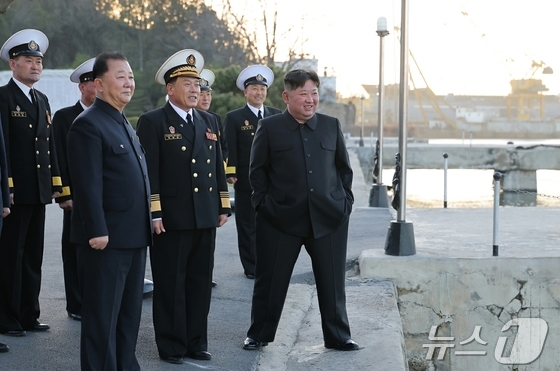
North Korea has explicitly stated the conditions and authority for the use of nuclear weapons in its constitution for the first time. In particular, by stipulating that the authority to use nuclear weapons can be delegated to a separate command organization in case of contingencies such as the incapacitation of Kim Jong Un, the General Secretary of the Workers’ Party, analysts on Thursday suggest that this sends the message that nuclear retaliation is possible even without the supreme leader.
North Korea, through the first session of the 15th Supreme People’s Assembly in March, revised Article 89 of its constitution to state that the authority to command the nuclear forces of the Democratic People’s Republic of Korea belongs to the Chairman of the State Affairs Commission. It further specifies that the Chairman of the State Affairs Commission can delegate the authority to use nuclear forces to the state nuclear force command organization. The State Affairs Commission in North Korea functions as the governing body, similar to the roles of the Blue House and the executive branch, with Kim serving as its chairman.
While existing nuclear powers also guarantee the authority of their military commanders to decide on nuclear use, North Korea’s move to codify this in its constitution is considered unprecedented.
Analysts suggest that North Korea’s decision to enshrine the supreme leader’s nuclear command authority in the constitution reflects an intention to emphasize nuclear weapons as the foundation of the regime’s existence and the state’s identity. This constitutional amendment is seen as establishing the equation Nuclear = Kim Jong Un regime.
What Happens in case of Kim’s Incapacitation… Nuclear Force Command Organization to Receive Delegated Authority
In the event of Kim’s incapacitation, would North Korea be unable to use its nuclear weapons? The short answer is no.
North Korea had already established provisions for automatic nuclear retaliation in its Nuclear Forces Policy Law, enacted in September 2022, in situations where nuclear weapons use is deemed necessary but the supreme leader and leadership are unable to make decisions.
Article 3, Paragraph 3 of this law, titled, Command and Control of Nuclear Forces, explicitly states that if the national nuclear force command and control system is endangered by an enemy attack, a nuclear strike will be automatically and immediately carried out according to pre-determined operational plans to annihilate the provocateurs, including their command and hostile forces.
The inclusion of nuclear-related content in the revised constitution can be seen as an effort to emphasize the intent and spirit of the Nuclear Forces Policy Law. Therefore, regardless of the constitutional amendment, North Korea has already prepared its own response plan for situations where Kim is incapacitated.
North Korea claimed in 2023 that it had established a nuclear weapons operation system called the Nuclear Trigger. This system appears to have been developed for nuclear weapons management and operational planning. It is believed to systematize the entire process from issuing nuclear alert levels to leadership discussions, Kim’s order issuance, and decision-making criteria for each situation leading to nuclear weapon launch.
The Nuclear Forces Policy Law mentions a nuclear force command organization composed of individuals appointed by the Chairman of the State Affairs Commission, which assists in all processes for nuclear weapons use. This suggests that in emergency situations, this organization would become the entity issuing nuclear use orders in place of Kim. The revised constitution also explicitly states that the Chairman of the State Affairs Commission can delegate the authority to use nuclear forces to the state nuclear force command organization. However, the specific composition and details of this command organization have not yet been revealed.
North Korea’s establishment of conditions and authority for nuclear weapons use appears to be a strategy to secure deterrence against external threats by emphasizing that nuclear retaliation is possible even if so-called decapitation operations targeting the North Korean leadership are carried out. The underlying message is that nuclear weapons will remain operational even if Kim dies, aiming to prevent preemptive strikes.
This approach may have been influenced by observing the conflict between the Donald Trump administration and Iran. In fact, President Trump, unlike his first term, attempted to annihilate Iran during his second term by considering strikes on Iranian nuclear facilities and eliminating Ali Khamenei and much of the leadership.
Nuclear War in Kim’s Absence Instills Fear… Actual Operation Remains Uncertain
However, it remains uncertain whether North Korea’s nuclear retaliation system would function normally in situations such as the death of General Secretary Kim. This is because a decapitation operation against the North Korean leadership would likely involve measures to incapacitate the decision-making abilities of not only Kim but also a wide range of North Korean leadership. There are also reports that the surveillance networks of South Korea and the U.S. are already monitoring most of North Korea’s nuclear and missile facilities.
Some analysts suggest that North Korea is keeping the composition of the state nuclear force command organization strictly confidential in consideration of this. This is because the organization could potentially serve as the last bastion of retaliation in case of emergency.
Experts note that there is a contradiction in North Korea’s approach of extremely concentrating nuclear weapons use authority in Kim’s hands while simultaneously introducing the logic that nuclear use is possible without him.
Shin Seung-ki, a researcher at the Korea Institute for Defense Analyses, stated that the main purpose is to deter U.S.-South Korea decapitation operations by instilling the perception that nuclear retaliation is possible even in Kim’s absence. It also reflects internal management concerns to prevent a power vacuum in nuclear control during urgent situations.
Park Won-gon, a professor of North Korean studies at Ewha Womans University, said that while North Korea aims to instill fear that nuclear war is possible even in Kim’s absence, the actual decision to use nuclear weapons would not be easy. This is because the moment nuclear weapons are used, the North Korean regime would face devastating retaliation.