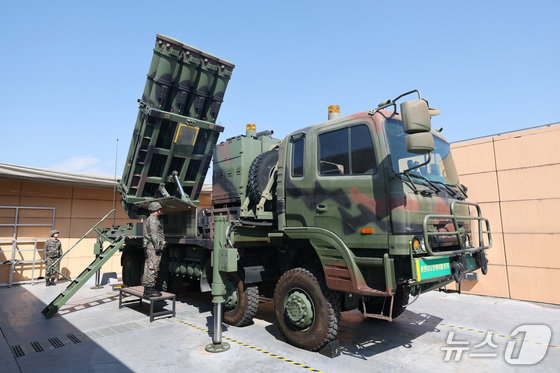
Battle stations! Battle stations! On Thursday at the Air Force base in Sacheon, Gyeongsang Province, sirens wailed, simulating a North Korean ballistic missile launch. Air Force personnel sprinted to their Cheongung-II medium-range surface-to-air missile launchers.
The troops swiftly cross-checked the Cheongung launchers and power supply systems, preparing for potential interception. Once checks are complete, they signal the command post to enter high alert status. Should a target enter the Cheongung-II’s engagement zone, the guided missile launches instantly to neutralize the incoming threat.
The Cheongung-II, operated by the Air Force’s 8146th Unit, is a cornerstone of South Korea’s missile defense system. This medium-range, medium-altitude surface-to-air guided missile system is controlled by a battalion command post, which coordinates multiple fire control radar launchers. Each launcher is armed with eight missiles.
The system boasts a top speed exceeding Mach 5 (about 1.7 km/s) and can engage targets at ranges from 20 to 50 km (about 12.4 to 31 miles), with an interception ceiling between 15 and 40 km (about 9.3 and 24.9 miles). A key upgrade from its predecessor, the Cheongung-I, is its expanded capability to intercept both aircraft and ballistic missiles.
The Air Force can mobilize to counter an enemy missile launch within approximately 10 minutes of detection, with response times shrinking dramatically as intelligence on the threat improves.
This rapid interception capability is made possible by an agile decision-making process centered on the Air Force Missile Defense Command’s Korea Air and Missile Defense (KAMD) Operations Center.
When an enemy launches a missile, a network of ground-based radars, Aegis destroyers, and early warning satellites detects the threat and relays data to the center. Analysts quickly assess flight parameters, launch site, and projected impact point before transmitting this intel to the operations control post.
Upon receiving the fire order, the Cheongung’s guided missile streaks toward its target. As it closes in, it activates a proximity fuse, ensuring a pinpoint strike on the hostile projectile.
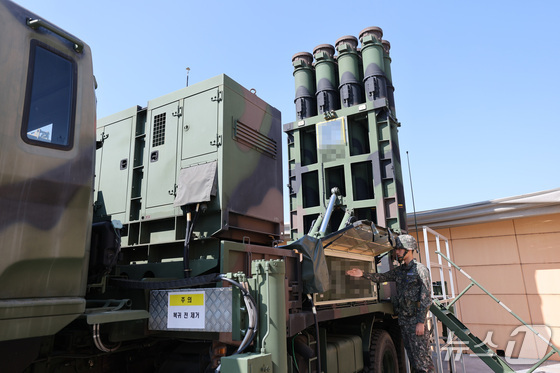
The Cheongung-II’s value is amplified in today’s battlefield, where adversaries often employ mixed salvos of ballistic missiles, cruise missiles, and drones.
It plugs a critical gap in South Korea’s layered air defense, covering the medium altitude band between 15 and 40 km (about 9.3 and 24.9 miles). This complements the low-altitude Patriot (PAC-3) and high-altitude L-SAM systems. Crucially, its independent radar and launcher units allow it to engage multiple incoming threats simultaneously.
During U.S.-Iran tensions, the Cheongung-II demonstrated its prowess with a reported 90% interception rate, marking a milestone for South Korean defense exports. It was the first combat use of a Korean weapon system to directly down enemy missiles.
Middle Eastern nations, including the United Arab Emirates (UAE), have employed the Cheongung-II against Iran’s mixed attacks of suicide drones and ballistic missiles. Its battlefield success has sparked discussions about additional purchases.
Major Kim Seung-tae, the battery commander overseeing the exercise, stated that they’ve honed the procedures to launch interceptors the instant we receive the order. The team is committed to safeguarding the airspace, ensuring our citizens can sleep soundly at night.