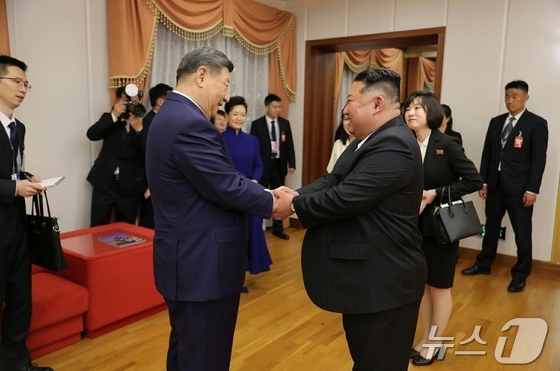
During Chinese President Xi Jinping’s state visit to North Korea, a summit with Kim Jong Un, the General Secretary of the Workers’ Party, took place. Notably, discussions about nuclear issues were conspicuously absent. On Tuesday, analysts expressed concerns that China’s tacit approval of North Korea’s self-proclaimed status as a nuclear power could significantly bolster Pyongyang’s position.
The Workers’ Party’s official newspaper Rodong Sinmun and Chinese state media released details of the summit. Both leaders emphasized enhancing strategic communication and expanding cooperation across political, economic, and military spheres. However, unlike reports from Xi’s visit seven years ago, there were no mentions of denuclearization or nuclear issues concerning the Korean Peninsula.
A Different Xi Jinping From Seven Years Ago as North Korea Grows Increasingly Defiant Toward China
During his previous visit in June 2019, Xi had placed significant emphasis on the importance of denuclearization. That meeting occurred after the collapse of the Hanoi Summit between Kim and then-President Donald Trump, effectively positioning Xi as a mediator overseeing North Korea’s actions.
In a 2019 commentary published in Rodong Sinmun, Xi stated that it supports the political resolution of the Korean Peninsula issue, reflecting China’s typical rhetoric supporting denuclearization talks through dialogue among North Korea, the U.S., and South Korea.
However, prior to this recent visit, Xi’s commentary in Rodong Sinmun took a different tone. He emphasized the need to oppose hegemony and coercive politics, suggesting that North Korea and China should coordinate their responses to U.S. actions. Notably, Xi also announced plans to enhance military cooperation with North Korea. This move could be interpreted as tacit recognition of North Korea’s nuclear armament, especially considering Pyongyang’s recent focus on advancing its nuclear capabilities.
North Korea reaffirmed its hardline stance on solidifying its status as a nuclear power just before Xi’s visit. On June 7, the day before Xi’s arrival, North Korea, through Kim’s sister Kim Yo-jong, declared that its status as a nuclear power is an absolute, irreversible reality, regardless of who recognizes it.
In what appeared to be a calculated move, Kim visited a uranium enrichment facility capable of producing weapons-grade nuclear material on June 3. On June 6, he inspected a facility that produces ballistic missile launchers. These actions seemed designed to send a message that China accepts North Korea’s status as a nuclear power.
As a permanent member of the United Nations (UN) Security Council, China has long officially supported the principle of denuclearization on the Korean Peninsula. Following North Korea’s nuclear tests, China participated in UN sanctions against North Korea, reaffirming its opposition to Pyongyang’s nuclear development.
However, in the past two to three years, China’s priorities have shifted from denuclearization to maintaining strategic cooperation with North Korea. This change appears to stem from Beijing’s desire to expand its influence over Pyongyang amid escalating strategic competition with the U.S. and to secure leadership in Northeast Asia.
Some experts suggest that China may now view North Korea’s nuclear capabilities as an irreversible reality. Given the significant advancement of North Korea’s nuclear arsenal, China has opted for strategic cooperation with North Korea as a more pragmatic choice than continuing to apply pressure for denuclearization.
Analysts also indicate that North Korea’s military presence could be seen as a strategic asset for China, especially as it responds to issues in the Taiwan Strait and the intensifying U.S.-China rivalry. North Korea appears to be pursuing diplomatic goals to solidify its status as a nuclear power through strengthened relations with China.
Professor Lim Eom-cheol from Kyungnam University’s Institute for Far Eastern Studies noted that China’s explicit intention to strengthen military exchanges suggests a significant shift from its previous diplomatic principles regarding denuclearization on the Korean Peninsula.
Chinese state media reported that Xi and Kim agreed to expand exchanges in diplomacy, law enforcement, and military fields, indicating future military cooperation between North Korea and China. Furthermore, the presence of North Korean Defense Minister No Kwang-chol and Chinese Defense Minister Li Shangfu at the summit suggests that practical discussions on cooperation may have taken place.
Some speculate that China’s references to military exchanges may serve as a counterbalance to the growing North Korea-Russia alliance. Hong Min, a researcher at the Korea Institute for National Unification, stated that viewing military exchanges as potential joint training is superficial. The underlying concern relates to the acceleration of North Korea’s modernization of nuclear and conventional weapons and the rapid evolution of combined military capabilities.
Hong added that China may seek to monitor changes in technology within North Korea’s military and the transfer of Russian technology through human exchanges and information sharing with North Korea.