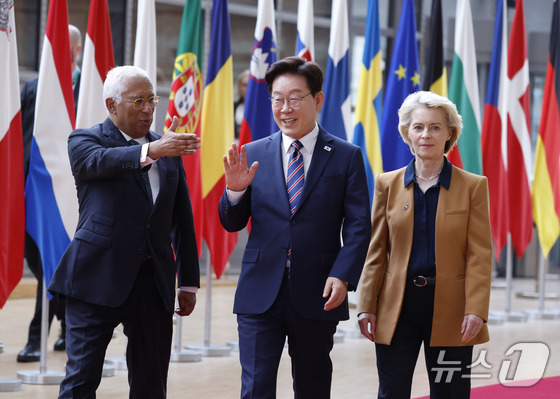
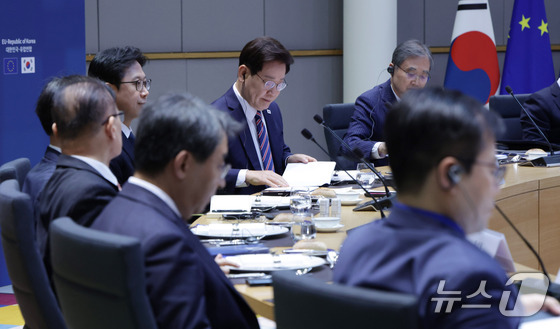
President Lee Jae Myung issued a joint statement with European Union (EU) leaders during their summit, which firmly rejected recognizing North Korea as a nuclear power and strongly condemned military support for Russia.
This represents the harshest criticism of North Korea since Lee’s administration took office. The statement reflects the EU’s stance, and compared to the 2023 Korea-EU summit joint statement, it shows some moderation in certain expressions.
The phrase complete, verifiable, and irreversible was simplified to complete denuclearization.
In 2023, then-President Yoon Suk Yeol announced 45 agreements through the Korea-EU summit joint statement.
Regarding North Korea’s nuclear and missile development (item 6), the Korea-EU leaders stated that it strongly condemns North Korea’s repeated illegal ballistic missile launches, ongoing nuclear development, and potential use of nuclear weapons, defining North Korea’s actions as a serious threat to international and regional peace and security.
They further demanded that North Korea immediately comply with the United Nations (UN) Security Council resolutions by dismantling all nuclear weapons, other weapons of mass destruction, ballistic missile programs, and existing nuclear programs in a complete, verifiable, and irreversible manner, and cease all related activities.
In the 2026 joint statement, President Lee and EU leaders expressed serious concerns about North Korea’s nuclear and ballistic missile programs, reaffirming their commitment to the complete denuclearization of the Korean Peninsula in line with UN Security Council resolutions. They added that North Korea must promptly comply with its non-nuclear weapon state obligations under the Nuclear Non-Proliferation Treaty (NPT) and fully adhere to the International Atomic Energy Agency (IAEA) Comprehensive Safeguards Agreement, including activating the additional protocol.
The statement emphasized that North Korea will never be recognized as a nuclear power under the NPT, nor will it hold any special status in this regard. It also called for all UN member states to fully implement relevant Security Council resolutions and urged North Korea to engage in meaningful discussions with all relevant parties.
The language has shifted from strongly condemning North Korea’s reckless actions to expressing serious concerns about its nuclear and missile programs.
However, the clear rejection of North Korea’s nuclear power status is notable, aligning with the South Korean government’s firm stance on denuclearization and the EU’s position.
The approach to demanding denuclearization has evolved, with the 2023 phrase complete, verifiable, and irreversible (CVID) simplified to complete denuclearization in 2026, reflecting a consensus between South Korea and the EU.
The Blue House explained that the government has consistently stated that North Korea cannot enjoy nuclear power status under the NPT and will maintain the goal of complete denuclearization of the Korean Peninsula.
The focus shifted from peaceful unification to peaceful coexistence, with strong condemnation of Russia-North Korea military cooperation.
The statement maintained the characterization of the Russia-Ukraine conflict as an aggressive war and added strong condemnation of Russia-North Korea military cooperation, reflecting North Korea’s involvement since 2023.
The past three years have seen a shift in approach to Korean Peninsula and North Korea policy.
In 2023, Korea-EU leaders supported South Korea’s bold initiative for a denuclearized, peaceful, and prosperous Korean Peninsula, and the EU backed free and peaceful reunification.
The 2026 statement reaffirmed commitment to peace and stability on the Korean Peninsula, supporting South Korea’s efforts to resume inter-Korean dialogue through expanded exchanges, normalized relations, and denuclearization to achieve peaceful coexistence and joint growth.
This marks a shift from supporting the bold initiative to backing efforts for inter-Korean dialogue resumption. The 2026 statement focuses on peaceful coexistence and joint growth rather than explicitly mentioning peaceful unification as in 2023.
The Blue House explained that this reflects support for the government’s policy of peaceful coexistence and joint growth, emphasizing tension reduction and trust-building between North and South Korea.
They added that the Korean Peninsula wording in the Korea-EU joint statement reflects both sides’ understanding of the issue and relevant UN Security Council resolutions, incorporating the government’s positions on each matter.