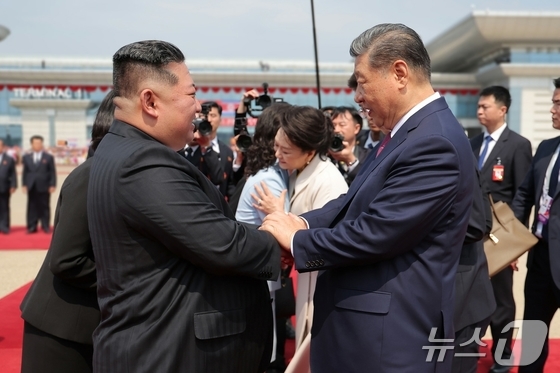
On June 12, analysts suggested that North Korea-China economic cooperation could evolve beyond mere trade expansion to encompass systemic collaboration in areas such as healthcare, sharing governance experiences, and border region development, coinciding with Chinese President Xi Jinping’s visit to Pyongyang.
In a recent report titled, Prospects for North Korea-China Economic Cooperation and South Korea’s Strategic Response, Oh Hyun-joo, a researcher at Kyungnam University’s Institute for Far Eastern Studies (IFES), predicted that the North Korea-China relationship is likely to develop into a pragmatic partnership. This partnership would combine North Korea’s national development strategy with China’s Northeast development plans.
Oh analyzed that the summit addressed key issues such as cooperation in economic trade, agriculture, construction, science and technology, and healthcare, as well as the full reopening of border trade zones. She noted the significance of the Chinese delegation including key economic and policy figures, such as the head of the National Development and Reform Commission, the Minister of Commerce, and the director of the Central Policy Research Office.
The researcher emphasized that the healthcare sector will be a critical area for future North Korea-China cooperation. While North Korea is expanding its medical infrastructure through projects like the Pyongyang General Hospital and the 20×10 Local Development Policy, it still lacks sufficient pharmaceuticals, medical equipment, specialized personnel, and operational experience in health systems. Consequently, Oh anticipates that North Korea will likely adopt China’s healthcare system and financial management practices.
Oh predicted that future North Korea-China cooperation will focus on transferring China’s institutional and systemic expertise to North Korea, rather than providing fragmented economic support. She cited the repeated emphasis on sharing governance experiences during recent high-level exchanges, suggesting that Chinese-style practices could significantly influence North Korea’s administrative and economic systems.
The expansion of cooperation in border regions is also noteworthy. If Xi’s mentioned full reopening of border trade zones materializes, it could significantly revitalize logistics and trade networks, particularly around Dandong. Oh highlighted recent developments, such as the renovation of customs facilities in the Dandong area, preparations for the New Yalu River Bridge opening, and moves to resume tourism to North Korea. These factors suggest that North Korea could expand its channels for procuring raw materials, equipment, pharmaceuticals, and construction materials from China.
However, Oh cautioned that unrestricted expansion of North Korea-China cooperation may face challenges due to international sanctions and U.S.-China relations. Instead, she anticipates limited but ongoing cooperation focused on border trade, logistics, tourism, healthcare, and livelihood sectors.
Oh emphasized that the expansion of North Korea-China economic cooperation should be viewed not merely as a strengthening bilateral relationship, but as an indicator of North Korea’s economic evolution. She urged for strategic preparation in anticipation of potential inter-Korean economic cooperation resumption.