

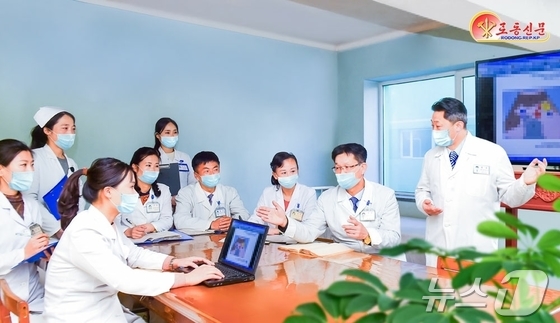
On June 28, North Korea’s official party newspaper, Rodong Sinmun, reported that the country’s virtual reality (VR) and augmented reality (AR) technologies are gaining recognition as innovative solutions in the medical field, expanding beyond their initial use in electronic entertainment.
The newspaper explained that VR technology creates immersive three-dimensional environments using computer graphics and simulation techniques, while AR overlays digital elements onto the real world, enabling users to experience otherwise inaccessible scenarios.
The report highlighted that the medical sector is currently adopting VR and AR technologies, sparking new advancements in diagnosis and treatment. While these technologies have primarily been used in electronic entertainment, the newspaper predicts their widespread implementation in healthcare in the near future.
Some medical facilities are already leveraging VR and AR to improve diagnostic and treatment accuracy. By converting two-dimensional (2D) images from computed tomography (CT) scans, magnetic resonance imagings (MRIs), and X-rays into three-dimensional (3D) models, healthcare professionals can examine affected areas with greater precision and depth.
The technologies are also being utilized in patient care. They help patients better understand their conditions and can reduce anxiety and pain during treatment procedures.
North Korea is exploring the potential of VR and AR in telemedicine as well. The newspaper suggested that these technologies could create a more comfortable and familiar environment for remote consultations, potentially improving healthcare quality for residents in rural or disaster-affected areas.
Since the 2000s, North Korea has prioritized information technology development as a national strategy, expanding research into computer graphics and simulation. Under Kim Jong Un’s leadership, the country has intensified its focus on scientific and technological advancements, including artificial intelligence (AI), VR, AR, and big data, as key components of its economic strategy.
While initial efforts centered on computer simulation and 3D visualization, recent applications have expanded to education, healthcare, and telemedicine. This shift likely aims to develop software-based technologies to compensate for inadequate medical infrastructure, especially given the challenges in acquiring advanced medical equipment due to international sanctions.