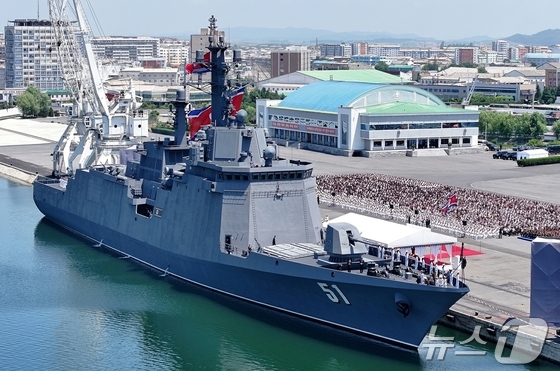
North Korea recently commissioned the Choe Hyon, its first 5,000-ton (Choe Hyon-class) multipurpose destroyer, launched last year. Analysts suggest this move aims to showcase the navy’s nuclear capabilities and expand its operational reach to both domestic and international audiences.
Hong Min, a senior researcher at the Korea Institute for National Unification, evaluated in a recent report that the Choe Hyon represents an offensive vessel integrating precision strike capabilities. These include supersonic cruise missiles, strategic cruise missiles, and tactical ballistic missiles on a single platform, symbolizing the navy’s nuclear armament.
On June 23, North Korea held a commissioning ceremony for the Choe Hyon at Nampo Port, attended by General Secretary Kim Jong Un. The vessel underwent operational capability evaluation for about 14 months after its launch before being assigned to the People’s Army Navy’s West Sea Fleet.
Hong noted that the timing of the Choe Hyon’s commissioning, shortly after recent party meetings, indicates North Korea’s intention to showcase its defense development achievements.
The Choe Hyon is not a conventional vessel but rather a nuclear strategic platform, marking a significant step in building long-range operational capabilities.
Hong interpreted Kim’s statement during the commissioning ceremony as a sign of North Korea’s confidence in its shipbuilding capabilities. He explained that this suggests North Korea has begun constructing follow-up vessels and established guidelines allowing for the construction of two ships annually.
Kim’s remarks indicate that North Korea intends to expand its navy’s mission from coastal defense to include strategic strikes and open-sea operations.
Hong assessed that North Korea aims to position the Choe Hyon as a nuclear strategic platform rather than a conventional combat ship. He noted that a 5,000-ton destroyer capable of carrying nuclear missiles could become central to enhancing naval power. However, Hong cautioned that North Korea must first establish related infrastructure such as supply ships and air support due to its lack of experience with large vessels.
The Choe Hyon’s assigned missions suggest North Korea may be planning operations targeting areas where U.S., South Korean, and Japanese forces operate. This could involve showcasing its presence near the Northern Limit Line or utilizing the vessel as a platform for strategic cruise missiles within range of allied bases.
The limitations of a base-less maritime nuclear platform remain a major variable in naval modernization. Hong projected that the increase in mobile maritime and underwater nuclear launch platforms will elevate surveillance and missile defense burdens on the U.S. and South Korea.
However, Hong predicted that the key issue would be when North Korea establishes the naval base infrastructure necessary to operate large vessels. Kim acknowledged this challenge during the commissioning ceremony.
Hong identified the imbalance between shipbuilding speed and base infrastructure development as a critical factor in North Korea’s naval modernization efforts.
Hong projected rapid progress in the deployment of additional 5,000-ton destroyers. The second ship is likely to be commissioned before October, with the third under construction for completion by October 10.
However, Hong cautioned that North Korea faces numerous challenges, including construction quality, maintenance, crew training, and weapons integration. He anticipated that North Korea’s maritime nuclear capabilities are more likely to develop gradually rather than being completed in the short term.