President Donald Trump has ordered a significant reduction in U.S.-South Korea joint military exercises, citing his good relationship with North Korean leader Kim Jong Un. This move comes just two days after South Korean President Lee Jae Myung proposed inter-party talks to end the long-standing conflict in his Liberation Day address. With both leaders extending olive branches to North Korea, the stalled dialogue on the Korean Peninsula may soon regain momentum.
However, the U.S.-South Korea joint exercise, Ulchi Freedom Shield (UFS), is currently proceeding as planned. This suggests that Trump’s actions are primarily seen as a political gesture toward Kim. North Korea, holding the key to these discussions, remains silent while flaunting its close ties with Russia. Analysts believe Kim’s response will be crucial in shaping the trajectory of potential dialogue.
Trump stated on his social media platform Truth Social that he’s displeased that the U.S. agreed to participate in joint military exercises with South Korea, given his very good relationship with North Korea’s Kim Jong Un. He added that since it’s too late to cancel, he has instructed former Secretary of Defense Pete Hegseth to significantly scale back the exercises. The previous day, Trump shared a photo with Kim from their 2019 meeting at the demilitarized zone (DMZ), highlighting their rapport.
The Blue House noted that it’s closely monitoring President Trump’s message and hope the friendly U.S.-North Korea relationship leads to meaningful dialogue. They cautioned against overinterpretation, stating that the U.S. and South Korea have been coordinating closely on joint exercises, and it’ll continue to collaborate on specific matters.
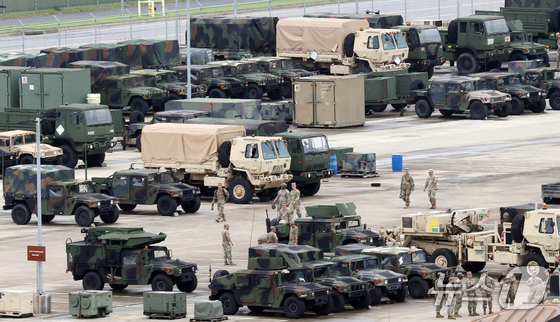
Nevertheless, the UFS joint exercises are proceeding as scheduled. This UFS period includes 14 field training exercises (FTX), already reduced from 17 last year. Reports indicate no specific U.S. requests for further scale adjustments. This suggests Trump’s directive aims to signal openness to dialogue with North Korea rather than alter training plans.
Trump has previously used joint exercises as leverage for U.S.-North Korea dialogue. After the 2018 Singapore summit, he abruptly halted joint exercises, scaling back or canceling major drills like Key Resolve. Analysts suggest that facing declining approval ratings due to the prolonged Iran conflict, Trump has again played the North Korea card as a diplomatic gambit before the November midterms.
Trump Revisits North Korea Card Before Midterms as North Korea Remains Silent Amid Closer Russian Ties
North Korea remains the wild card. Just days before Trump’s message, North Korea’s Foreign Ministry labeled the UFS as an invasion warfare demonstration, hinting at potential military displays. They’ve ignored President Lee’s proposal and continue to emphasize their relationship with Russia under a hostile states framework.
Some speculate that North Korea might use another U.S.-North Korea summit to gain de facto nuclear power recognition. Victor Cha, Korea Chair at the Center for Strategic and International Studies (CSIS), recently predicted that if Republicans lose in November, Kim might seek a post-election summit. A new meeting could prioritize peace treaty discussions, joint exercise suspension, and ending hostilities, while delegating denuclearization talks to working-level teams.
Chinese Foreign Minister Wang Yi’s likely visit to South Korea on August 19-20 adds another variable. The government plans to request China’s help in bringing North Korea back to the negotiating table. They also aim to use the UN General Assembly in September and November’s Asia-Pacific Economic Cooperation (APEC) summit in Shenzhen as opportunities to build dialogue momentum under their peacemaker strategy.
North Korea and China have been rekindling their relationship following President Xi Jinping’s June visit to North Korea. However, China’s role in inter-Korean relations remains uncertain. At the June summit, China avoided direct mention of denuclearization and has stressed “simultaneous action” from the U.S. and South Korea to resolve the nuclear issue.
While diplomatic and security officials view Trump’s message positively for U.S.-North Korea dialogue, they believe conditions aren’t yet ripe for immediate talks, given North Korea’s silence. They note that North Korea’s response is crucial, with China’s mediator role and the Russia-Ukraine war’s impact on North Korea-Russia ties as additional variables.
Even if U.S.-North Korea talks resume, preventing Korea passing – the U.S. bypassing South Korea – and ensuring negotiations focus on denuclearization rather than nuclear arms reduction remain challenges. If South Korea is sidelined and North Korea’s nuclear status tacitly accepted, security threats could paradoxically increase.