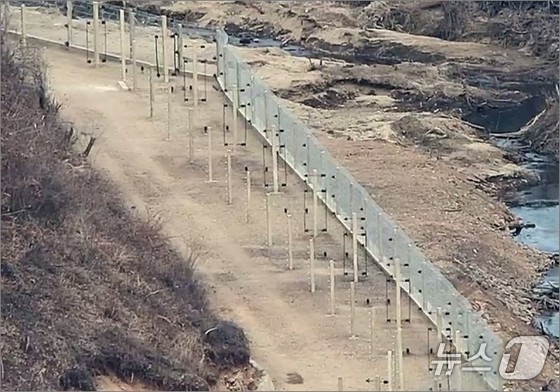
North Korea continues to bolster its military presence along the border, deploying 240mm and 600mm multiple rocket launchers, self-propelled artillery, and unmanned aerial vehicles. U.S. military officials project that the so-called border fortification project, which has been ongoing near the Military Demarcation Line (MDL) since 2024, will be completed around 2028.
In response to North Korea’s military buildup in the border region, U.S. and South Korean forces plan to enhance surveillance capabilities, firepower, and anti-drone defenses, while also intensifying joint exercises and training.
A report submitted by the Department of Defense to the Congressional Armed Services Committee on Thursday reveals that North Korea has been conducting borderization operations since April 2024. This follows Kim’s December 2023 declaration of inter-Korean relations as two hostile states. The construction includes establishing no-man’s lands, erecting barbed-wire fences, and laying minefields along the MDL.
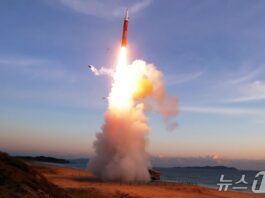
The Pentagon estimates this construction will be completed by 2028. Intelligence assessments indicate that North Korea is continuously upgrading its military capabilities in the border area, introducing new 240mm and 600mm rocket launchers, self-propelled artillery, and unmanned aerial systems. On August 6 and 12, North Korea launched ballistic missiles into the Sea of Japan, which defense officials interpret as a provocative response to the upcoming U.S.-Republic of Korea (ROK) joint exercise Ulchi Freedom Shield (UFS).
U.S. and South Korean forces plan to maintain real-time surveillance of North Korean activities near the MDL and respond according to established protocols in case of incursion, while also implementing measures to prevent accidental engagements. They reported plans to upgrade artificial intelligence (AI) powered Ground Operations Post (GOP) surveillance systems, deploy advanced unmanned ground sensors, and enhance reconnaissance drone and ground surveillance equipment capabilities.
To counter North Korea’s new rocket launchers, self-propelled artillery, and tactical missiles deployed near the border, the Pentagon stated it will update potential targets and strengthen counter-battery systems. Plans include integrating division-level artillery radar, deploying the Cheonmu multiple launch rocket system, and establishing a comprehensive anti-drone defense network for the border region and deep rear areas.
The Department of Defense reaffirmed its commitment to bolstering the U.S.-ROK combined defense posture. They aim to refine alliance crisis management and warfighting procedures through joint exercises, conducting year-round training with a focus on combined exercises at the battalion level and above. During exercise periods, they will execute essential field maneuvers linked to exercise scenarios.
Regarding the transfer of wartime operational control, defense officials reported plans to finalize a roadmap this year to expedite the transition. The timing of the transfer will be determined after verifying the future combined command’s full operational capability (FOC) at the U.S.-ROK Security Consultative Meeting (SCM).
Furthermore, the Pentagon disclosed ongoing negotiations with South Korea for the transfer of nuclear fuel technology, maintaining the principle of domestic construction for the nuclear-powered submarine program. The South Korean government aims to establish the necessary legal and regulatory framework for nuclear submarine construction by 2027 through special legislation and nuclear safety regulations.