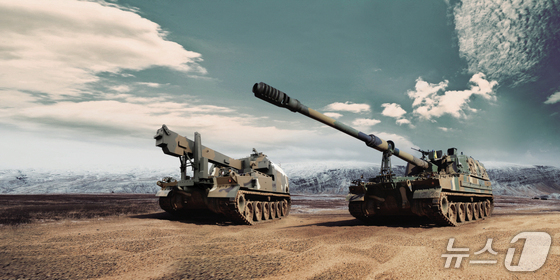
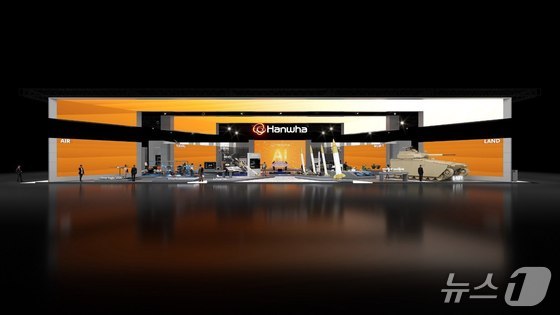
Hanwha Aerospace, a leader in K-defense exports with products such as the K9 self-propelled howitzer and the Cheonmu multiple launch rocket system, will showcase advanced artificial intelligence (AI)-powered weapon systems at the Seoul International Aerospace and Defense Exhibition (ADEX) 2025. The event runs for five days starting on October 20 at Korea International Exhibition Center (KINTEX) in Goyang, South Korea.
The company aims to demonstrate solutions to maintain robust national defense amid demographic challenges while pursuing export opportunities with international customers at the exhibition.
Hanwha Aerospace to Unveil AI-Enhanced Systems Including the Cheonmu with Kamikaze Drone Capability and Fully Autonomous K9 Self-Propelled Howitzer
The exhibition will feature a range of Hanwha’s AI-integrated products. Notably, next-generation versions of their export bestsellers—the Cheonmu multiple rocket launcher and the K9 self-propelled howitzer—will be presented.
A highlight will be the debut of their next-gen export product, the loitering precision-guided munition (L-PGW), a key component of the forthcoming Cheonmu 3.0 system. This innovative design incorporates a kamikaze drone into the nose of the standard 80 km (about 50 miles) range Cheonmu rocket. After launch, the drone utilizes AI for target acquisition, relaying data via satellite link before detaching for the terminal attack phase.
The K9 lineup will include the K9A3 model, designed for fully unmanned operations. While the K9A2—scheduled for deployment in 2027—reduces the crew from five to three through turret automation, the K9A3 aims for complete autonomy. Its AI enables a single fire control vehicle to direct up to three K9 units in autonomous maneuvers.
Additionally, the company will showcase its Korean-developed tracked unmanned ground vehicle (UGV), the Temis-K, alongside smaller UGVs such as the Arion-SMET and GRUNT. The Temis-K, optimized for Korean requirements, combines a tracked platform from Europe’s Milrem Robotics with Hanwha’s remote-controlled weapon station (RCWS).
Hanwha Aerospace plans to become a global leader in the UGV market by 2028 by offering a full range of small, medium, and large wheeled and tracked platforms. This strategy was strengthened by an expanded technology partnership with Milrem Robotics in February.
Boosting Exports Through Localization: Joint Venture with Poland’s WB Group, MOU with Estonian Tech Firms
Following its 2023 merger of Hanwha Defense and Hanwha Aerospace, the company is aggressively targeting European and Middle Eastern markets. These regions are ramping up defense spending due to the Russia-Ukraine conflict and other geopolitical factors. Hanwha is also setting its sights on the U.S., aiming to become a top-tier global defense firm with annual sales of 70 trillion KRW (about 49.3 billion USD) and operating profits of 10 trillion KRW (about 7 billion USD) within a decade.
Recent export wins continue to bolster Hanwha’s position. A prime example is last month’s contract with Norway for an additional 24 K9 howitzers. This third K9 sale to Norway, following deals in 2017 and 2022, reaffirms the system’s competitiveness and strengthens Hanwha’s foothold in the Nordic defense market.
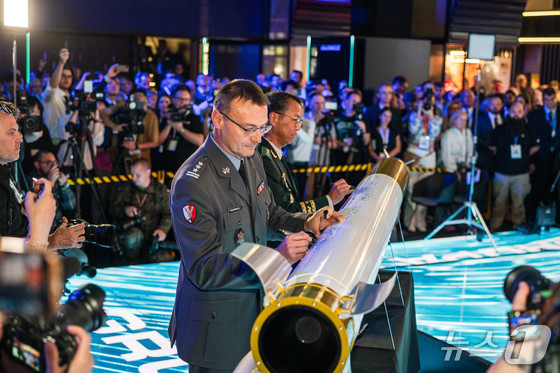
A cornerstone of Hanwha Aerospace’s export strategy is localization. In September, they finalized an agreement to establish a joint venture with Poland’s WB Group, the country’s leading private defense firm, for in-country production of Cheonmu missiles.
This joint venture will manufacture the 80 km (about 50 miles) range guided rockets (CGR-080) for Poland’s Homar-K system, the export variant of Cheonmu. The partnership includes setting up local production facilities and creating jobs in Poland. While the initial output will prioritize Polish needs, the partners aim to expand exports to other European nations. They also plan to diversify their munition offerings for the export market.
Industry analysts view such localization efforts as crucial, given Europe’s increasing preference for intra-bloc defense procurement. Hanwha Aerospace intends to expand its export reach not only through joint ventures but also by establishing local production capabilities.
The company’s strategy of tailoring solutions for each target market is seen as another competitive advantage. Last month, Hanwha Aerospace signed an memorandum of understanding (MOU) with Estonian information technology (IT) firms Nortal and SensusQ to co-develop an Estonian-specific battlefield management system (BMS). This initiative supports their push into Estonia’s infantry fighting vehicle (IFV) market.
Hanwha Aerospace Intensifying its R&D Efforts to Enhance its Technological Edge and Influence in the Global Defense Industry
The company is involved in developing the high-altitude interceptor missile (L-SAM-II) system, capable of engaging ballistic threats above the stratosphere (10-50 km, about 6.2-31 miles). L-SAM-II represents a significant upgrade over the existing L-SAM, with interception altitudes reaching into near-space. It is hailed as the ultimate evolution of South Korea’s air defense, expanding coverage by 3-4 times compared to its predecessor.
Building on the anti-ballistic missile (ABM) technology developed last year, Hanwha aims to perfect the L-SAM-II’s advanced guidance systems. Key innovations include the divert and attitude control system (DACS) and the propulsion unit. The DACS employs ten thrust-vectoring valves for precise control of the hit-to-kill interceptor—a technology mastered by only a handful of nations, including South Korea and the U.S.
Another recent milestone is the completion of the Korean Vertical Launch System (KVLS-II), a five-year joint effort with government defense agencies. This public-private collaboration yielded a versatile launch platform capable of firing various guided weapons—an essential capability for South Korea’s naval modernization.
KVLS-II’s greatest strength lies in its multi-mission flexibility. Standardized interfaces allow a single cell to accommodate different missile types, enabling ships to rapidly reconfigure for anti-ship, land-attack, or air defense roles as needed. The system’s modular design ensures that a malfunction in one cell will not compromise the entire launcher. KVLS-II will debut on the Aegis destroyer Jeongjo the Great (KDX-III Batch II) later this year and is slated for integration on future Korean destroyers such as the KDDX.
Expanding Beyond Land Systems: Space, Aerospace, and Maritime Sectors
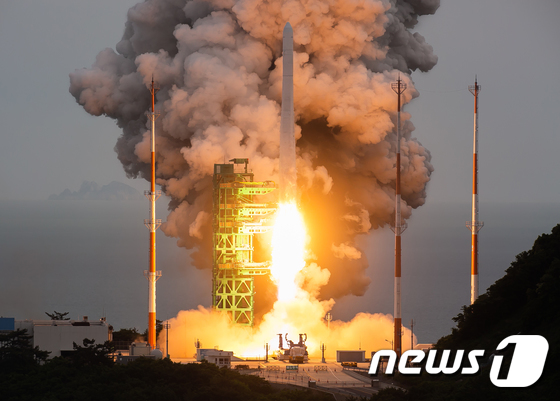
Hanwha Aerospace is diversifying its portfolio beyond traditional land systems. In March 2022, the company was selected to lead production for South Korea’s next-generation space launch vehicle program. As the prime contractor for upgrades to the Korean Space Launch Vehicle II (KSLV-II) Nuri, Hanwha is preparing for its fourth launch this November. Following the successful third flight in 2023, Nuri is scheduled for three additional launches through 2027. Leveraging this experience, Hanwha plans to enter the commercial space logistics market.
In the aerospace sector, the company produces engines for key Republic of Korea Air Force platforms such as the F-15K fighter and the T-50 advanced trainer. They also manufacture the domestically-developed powerplant for the Surion utility helicopter. Hanwha leads propulsion system integration for the KF-21 Boramae fighter jet program while pushing to localize critical engine components.
Last year’s collaboration with SK Enmove resulted in the world’s first non-flammable marine energy storage system (ESS), a major breakthrough for maritime applications. This positions Hanwha to capture market share in the burgeoning eco-friendly ship sector with cutting-edge green energy solutions. The company’s maritime portfolio also includes LM2500 gas turbines for naval vessels.