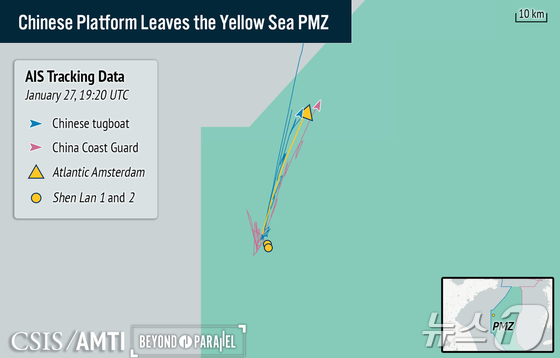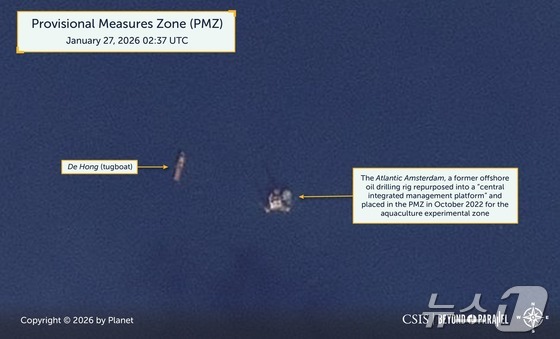
China has begun relocating a maritime management platform it illegally installed in the Korea-China Provisional Measures Zone (PMZ) in the West Sea. On Wednesday, the U.S. think tank Center for Strategic and International Studies (CSIS) confirmed the structure’s movement through satellite imagery and Automatic Identification System (AIS) analysis.
In a report released that day, CSIS revealed that the management platform, dubbed Atlantic Amsterdam, started moving northward under tow at approximately 7:30 p.m. Korean time on Tuesday.
CSIS’s comprehensive analysis of commercial satellite imagery and automatic identification system (AIS) data showed the structure being escorted by Chinese tugboats De Hong and Weixiaotuo 1, along with the Chinese Coast Guard vessel Zhongguohaijian 4073, as it moved toward the PMZ boundary.
Satellite images captured at 11:37 a.m. on Tuesday showed the platform still in its original position. However, AIS signals indicated movement began around 7:30 p.m., about eight hours later. By 4:20 a.m. on Wednesday, the structure had approached within 8 nautical miles (about 15 km) of the PMZ boundary. Subsequently, AIS signals from the platform and some support vessels were lost.
CSIS assessed that based on its last known position, the platform has likely exited the PMZ or is very close to the boundary.
During a regular press briefing on Tuesday, the Chinese Foreign Ministry stated that a Chinese company is currently conducting operations to relocate the management platform, describing it as an autonomous adjustment based on the company’s operational and development needs.
Chinese Foreign Ministry spokesperson Guo Jiakun emphasized that China’s position on fishing and aquaculture facilities in the South China Sea and Yellow Sea (West Sea) remains unchanged. He noted that China and South Korea, as maritime neighbors, maintain close communication on marine-related issues, manage differences appropriately, and promote mutually beneficial cooperation.
Reports indicate that there has been clear communication between China and South Korea regarding the relocation of the management facility outside the PMZ.
The South Korean government has positively evaluated this relocation as part of the implementation of an agreement between the Chinese and South Korean leaders.
South Korea’s Foreign Ministry confirmed the platform’s movement toward China, outside the PMZ, calling it a significant development. The presidential office also welcomed the relocation, which has been a source of concern, and stated that discussions would continue to make the West Sea a peaceful and prosperous area.
The Atlantic Amsterdam, originally an oil drilling facility, is a semi-fixed structure that China converted into a maritime management platform. It is equipped with a helicopter landing pad and personnel accommodations.
While China has claimed the platform is for fishery management, South Korea has expressed concerns that it could be used as a base for monitoring and controlling the waters. China’s installation of deep-sea aquaculture facilities Xenlan 1 and Xenlan 2 in the PMZ in 2018 and 2024, respectively, followed by this management platform in 2022, has escalated tensions.
CSIS assessed that while this action could temporarily ease tensions between China and South Korea, the handling of the two remaining aquaculture facilities in the PMZ will be crucial for future conflict resolution.
CSIS noted that the management platform has been the most contentious of the three structures. How China manages the remaining aquaculture facilities will determine whether this relocation is a limited concession or leads to broader efforts to stabilize the situation.