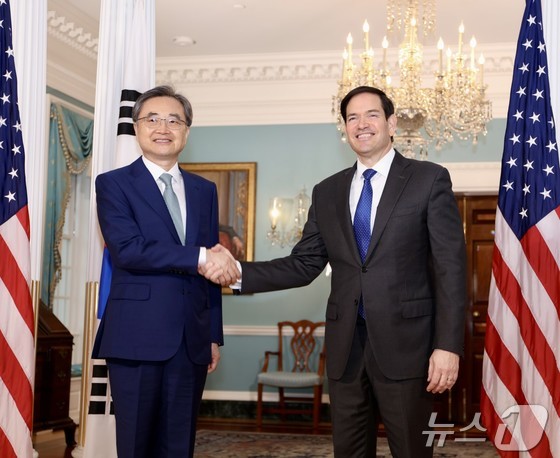
As President Donald Trump threatens to raise tariffs on South Korea to 25%, South Korean Foreign Minister Cho Hyun is set to meet with U.S. Secretary of State and National Security Advisor Marco Rubio for formal diplomatic talks in Washington, D.C. on Tuesday.
All eyes are on whether South Korea can persuade the U.S., which has been critical of delays in South Korean investment-related legislation, to find a solution to the mounting pressure for tariff increases.
The South Korean Ministry of Foreign Affairs announced on Monday that the two ministers will engage in comprehensive discussions on bilateral issues, including strategies to expedite the implementation of their joint fact sheet.
Initially, Minister Cho planned to hold an informal meeting with Secretary Rubio during the “Ministerial Meeting on Critical Minerals” hosted by the U.S. State Department on Wednesday.
However, the sudden decision to hold formal diplomatic talks just a day before Minister Cho’s visit has drawn significant attention. Reports suggest that the U.S. swiftly agreed to South Korea’s request for this meeting.
Unlike informal meetings that typically last 10-20 minutes, involve minimal staff, and rarely produce official outcomes, formal diplomatic talks involve pre-coordinated agendas, include working-level officials, and may result in joint statements or briefings, depending on the agreements reached.
This U.S.-South Korea foreign ministers’ meeting is particularly noteworthy as it suggests the U.S. is officially opening negotiations with South Korea at a time when it’s considering concrete tariff increases.
According to reports, the upcoming critical minerals ministerial meeting will include not only South Korea but also G7 nations, the European Union, India, Australia, Mexico, New Zealand, and key mineral-rich countries from Africa and Asia.
The fact that the U.S. is dedicating substantial time to formal talks with South Korea, among dozens of participating countries, indicates strong recognition of the need for dialogue with Seoul.
The Trump administration is eagerly awaiting the final ruling on the legality of mutual tariff impositions based on the International Emergency Economic Powers Act (IEEPA), which it has used as leverage in trade negotiations with South Korea, Japan, and the EU.
With the U.S. Supreme Court potentially issuing its ruling as early as February 23, the U.S. may be motivated to see tangible progress on investment-related matters with South Korea, which could favorably influence the court’s decision.
On January 26, President Trump said on Truth Social that he intended to raise tariffs on South Korea to 25%, arguing that U.S. trade agreements are crucial and that while the United States has swiftly reduced tariffs under those agreements, it expects trade partners to reciprocate, effectively calling for prompt investment from South Korea.
In response to Trump’s bombshell statement, South Korea’s Minister of Trade, Industry and Energy Kim Jong Kwan was urgently dispatched to the United States on January 28 and met twice with U.S. Secretary of Commerce Howard Lutnick. Upon returning, Kim said he believed they had cleared up any unnecessary misunderstandings, but did not disclose specific solutions.
Following Kim’s trip, Yeo Han-koo, head of South Korea’s Office of International Trade and Legal Affairs, is also visiting the United States to meet with government officials, members of Congress, and industry representatives to address the situation. He is expected to remain in the country until the 5th and to meet with U.S. Trade Representative Jamieson Greer.
With both industry and trade leaders visiting the U.S. and with a formal meeting between foreign ministers now underway, South Korea’s top priority is to persuade the U.S. to commit to withdrawing the proposed tariff increase.
Given that Secretary Rubio also serves as National Security Advisor, some analysts believe this meeting could significantly influence the U.S. decision on whether to retract the tariff increase on South Korea.
Meanwhile, as the Trump administration has recently unveiled its National Security Strategy (NSS) and National Defense Strategy (NDS), this foreign ministers’ meeting is expected to reaffirm the importance of the U.S.-South Korea alliance and discuss cooperation on various diplomatic and security issues, including alliance modernization, North Korea policy coordination, and strengthening trilateral cooperation with Japan.
In light of the U.S. intensifying military pressure on Iran, discussions on South Korea’s potential cooperation on Middle Eastern issues, such as participation in the Gaza Peace Commission, may also be on the agenda.