

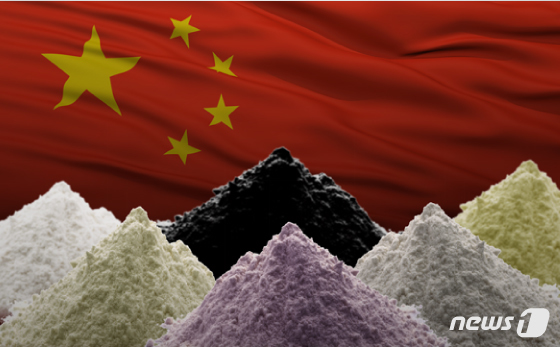
In the wake of last month’s South Korea-China summit, analysts are noting a warming trend in bilateral relations. Meanwhile, as the U.S. pushes to establish a trade bloc to restructure critical mineral supply chains, experts argue that South Korea’s situation-specific strategic choices between the U.S. and China are becoming increasingly crucial.
On Wednesday, the Trump administration launched FORGE (Forum for Resource Governance and Engagement) during a ministerial meeting on critical minerals in Washington, D.C. This forum aims to diversify the supply chain for essential resources.
FORGE is essentially a revamped version of the Minerals Security Partnership (MSP), which was initiated under the Biden administration in June 2022. It can be viewed as Trump’s take on the MSP.
South Korea, along with the G7 nations and the European Union, which together had 17 member countries participating in the MSP, automatically became members of FORGE. The U.S. is currently working to expand participation to 55 countries. While the U.S. doesn’t explicitly mention China, analysts suggest that this trade bloc is ultimately designed to counter Chinese influence.
Even during the MSP’s inception, the U.S. identified rare earth elements, lithium, nickel, and manganese as key minerals for cooperation, seeking to reduce China’s dependence among participating countries. However, many experts believe that FORGE will adopt a more aggressive stance toward China than the MSP.
As a founding member of the MSP, South Korea has strived to ensure its voice is heard from the beginning. Despite concerns that South Korea-China relations would deteriorate when the MSP was launched, South Korea managed to simultaneously pursue bilateral supply chain cooperation with China.
However, observers speculate that Trump’s FORGE might differ from the MSP. Even when the Biden administration launched the MSP, concerns about China’s weaponization of rare earth elements persisted. The key difference now is the presence of President Trump, armed with his America First ideology. Analysts predict that the Trump administration may pressure South Korea to participate in more explicit efforts to counter China.
Last year, the U.S. suffered significant impacts across various industries, including defense, semiconductors, and batteries, due to China’s de facto export controls on critical minerals, including rare earths. The two countries nearly reached a breaking point over high tariffs before agreeing to a trade truce at a meeting in Gyeongju in October, and have maintained a managed relationship since then.
Ahead of President Trump’s April visit to China, the leaders of both countries spoke by phone on Wednesday, apparently maintaining the current atmosphere. However, China has requested that the U.S. refrain from selling weapons to Taiwan, while the U.S. has asked China to increase purchases of oil, gas, and agricultural products like soybeans. Analysts warn that tensions could flare up at any moment.
If U.S.-China tensions escalate, there are concerns that a China-containment group based on FORGE could become a target of Chinese retaliation.
Separately from FORGE, the U.S. is pursuing other multilateral cooperation mechanisms with the European Union and Japan, and is also signing bilateral memoranda of understanding (MOUs) on mineral cooperation with individual countries.
The U.S. has requested an MOU with South Korea, but the South Korean Foreign Ministry states that it is still under review. So far, the U.S. has not requested South Korea’s participation in the multilateral cooperation mechanism.
Analysts warn that the U.S.’s expansion of trade blocs may create potential points of conflict for South Korea with China. For instance, China has historically viewed South Korea as the weak link in trilateral cooperation among South Korea, the U.S., and Japan, and has applied pressure accordingly.
For South Korea, entering into a bilateral mineral cooperation MOU with the U.S. requires careful consideration of alliance-level cooperation while also managing its relationship with China.
China has already expressed displeasure with the bloc-building efforts, including FORGE, and has indicated that it will closely monitor the situation. Lin Jian, a spokesperson for the Chinese Foreign Ministry, said at a regular briefing on Thursday that China opposes efforts to undermine the international economic and trade order through small rules.
Professor Hwang Jae Ho of Hankuk University of Foreign Studies said that for South Korea, it would be best to delay the U.S. bilateral MOU as much as possible while comprehensively reviewing the mutual tariffs and security issues currently at stake.