On Monday, Harold Rogers, the interim Chief Executive Officer (CEO) of Coupang’s South Korean branch, appeared before the U.S. House Judiciary Committee for a closed-door investigation that lasted about seven hours.
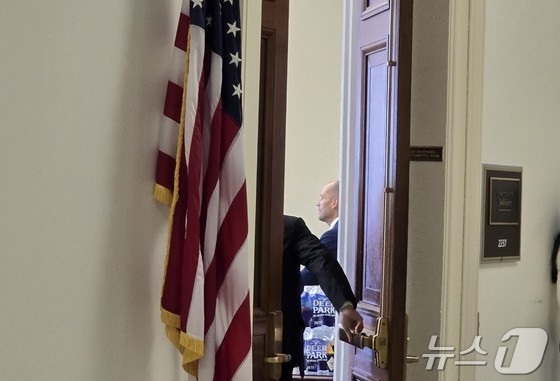
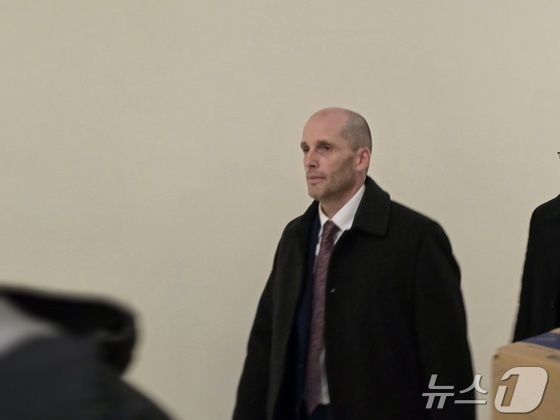
Rogers entered the committee meeting room, located in Room 2237 on the second floor of the Rayburn Building in Washington, D.C., at approximately 9:42 a.m.
When Korean reporters asked about his stance for the day, Rogers remained silent as he entered the hearing room.
During the meeting, it appears that committee staff and legal representatives focused on hearing testimony from Rogers and other Coupang officials.
Republican Representatives Jim Jordan, the chair of the House Judiciary Committee, and Scott Fitzgerald, chair of the Regulatory Reform and Antitrust Subcommittee, who had issued the subpoena to Rogers, were not seen at the hearing.
Even during lunch, only the committee’s legal representatives and staff briefly left the meeting room. Rogers and other Coupang representatives were spotted through a crack in the door eating delivered food such as sandwiches and salads.
A spokesperson for the committee told Korean reporters outside the hearing room that everything was discussed in the meeting, but due to the private nature of the testimony, specific details could not be disclosed.
Rogers left the meeting room around 5:02 p.m., approximately seven hours after entering.
He declined to answer questions about the main agenda of the day or the content of his testimony as he exited the building.
On February 5, Jordan and Fitzgerald issued a subpoena to Rogers demanding his deposition. In an accompanying letter, they requested all records of communications with the South Korean government and written materials regarding the potential impact of South Korean investigations on Coupang’s business.
The House Judiciary Committee is expected to question Rogers based on these records to determine whether various sanctions from the South Korean government constitute discriminatory treatment against Coupang.
In their letter, the representatives pointed out that despite trade agreements ensuring non-discrimination against American companies, South Korean regulatory authorities have repeatedly engaged in discriminatory treatment, unfair enforcement, and threats of criminal penalties.
They also claimed that President Lee Jae Myung demanded active penalties and hefty fines against Coupang, and that the Fair Trade Commission hinted at a potential business suspension for the company.
The representatives explained that to protect American businesses and citizens from discriminatory laws and enforcement by foreign governments, the committee must investigate the scope and nature of these efforts, as well as how they affect the procedural rights of Americans and global competitiveness.
In light of the Coupang incident, the committee has officially stated its intention to conduct a thorough investigation into whether the South Korean government’s digital regulations infringe upon the due process and global competitiveness of American companies, and to pursue new protective legislation to block foreign government regulations.
Rogers was appointed as the interim CEO of Coupang’s South Korean branch following a massive data breach that affected 33.7 million individuals. Initially, the South Korean National Assembly planned to summon both Kim Beom-seok, the chairman of Coupang Inc. (U.S. headquarters), and Rogers for a hearing, but only Rogers appeared before the National Assembly’s Science, Technology, Information, and Broadcasting Committee last December. Subsequently, Rogers faced police investigations for allegations of evidence tampering and perjury.
This summons occurs amid heightened sensitivity from both Congress and the administration regarding foreign government regulations on domestic tech companies, drawing significant attention.
Although the Supreme Court ruled that the tariffs imposed by President Donald Trump under the International Emergency Economic Powers Act (IEEPA) were illegal, Trump decided to implement a 15% global tariff starting on the 24th, utilizing Trade Act Section 122.
The Trump administration has been pressuring trading partners, including South Korea, through Trade Act Section 301, which grants the administration authority to impose tariffs in response to unfair or unreasonable discriminatory policies and practices by foreign governments.
In South Korea’s case, there is a high likelihood of raising concerns about discrimination against digital technology companies.
Recently, the U.S. government has argued that newly proposed online platform legislation and the recently enacted law to combat misinformation (amendments to the Information and Communications Network Act) discriminate against American tech companies.