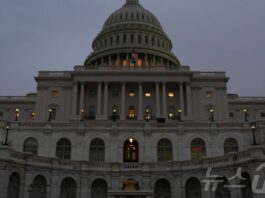
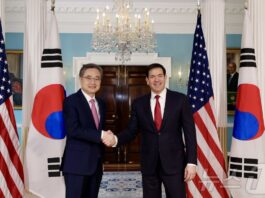
On Monday, U.S. President Donald Trump ramped up pressure on countries hosting American troops, including South Korea, Japan, and Germany, to join naval escort operations in the Strait of Hormuz.
After highlighting South Korea’s heavy reliance on the Strait for its energy industry, Trump publicly aired his frustration, questioning why these nations wouldn’t help despite long-standing U.S. protection.
During an executive order signing at the White House Oval Office, Trump addressed the Hormuz Strait issue, stating that they’ve got 45,000 troops in Japan, 45,000 in South Korea, and 45,000 or 50,000 in Germany defending all these countries.
He added that but when he asks about minesweepers, they say they don’t want to get involved. They’ve been protecting you for 40 years.
It’s worth noting that Trump’s figures for U.S. troops in South Korea are inaccurate. The actual number is around 28,500, though Trump has previously inflated this to 45,000.
He also pointed out that China depends on the Strait for 91% of its oil, Japan for 95%, and South Korea relies heavily on it for oil and energy. Trump insisted that they should be grateful to the U.S. and help them out.
Later that day, at a Trump-Kennedy Center board luncheon at the White House, without naming specific countries, Trump mentioned deploying 45,000 great soldiers to protect certain nations from danger.
He remarked that they’ve protected you for 40 years, and questioned about now you’re saying you don’t want to get involved in a minor issue when they (Iran) have little ammo left and actual fights are unlikely?
In response to Iran’s threats to block the Strait of Hormuz, Trump had previously requested via Truth Social that five countries—South Korea, Japan, China, the UK, and France—send warships to ensure safe passage.
On March 15, he told reporters he’d asked about seven countries to send warships for tanker escorts and Iranian attack preparedness, up from the initial five, though he didn’t specify which seven.
Trump’s statements appear to be an attempt to increase pressure on key allies who have been cautious about U.S. deployment requests.
The day before, the South Korean presidential office stated they were in close communication with the U.S. regarding Trump’s request but would make a careful decision.
Japanese Prime Minister Sanae Takaichi recently said that it hasn’t made any decisions on sending vessels. They’re still reviewing what Japan can do independently and within legal bounds. With a summit with Trump scheduled for March 19 in Washington, D.C., her stance during the meeting will be closely watched.
Germany has clearly stated that it is not a party to this war and will not participate.
Although Trump cited incorrect troop numbers for South Korea, his specific references could be seen as a veiled threat to potentially reduce troops in these countries if they remain uncooperative.
The previous day, upon returning to the White House from Mar-a-Lago, Trump remarked that whether it gets support or not, it’ll remember their decision.
In a Financial Times phone interview, he warned that if allies don’t join military operations to open the Strait of Hormuz, the North Atlantic Treaty Organization’s (NATO) future could be in jeopardy.
Regarding China, he initially threatened to postpone his summit with President Xi Jinping if they didn’t cooperate, but later announced a one-month delay.
China effectively rejected Trump’s request for naval deployments, urging all countries to cease military actions and avoid escalating tensions.
A Washington, D.C. foreign policy expert noted that Trump often criticizes allies for free-riding on U.S. security. The U.S. expects allies to step up in these situations.
Another expert suggested that while direct military involvement might be difficult for allies like Japan or South Korea, limited contributions such as mine-clearing or intelligence support could be viable options.
Japanese media reported that the government is considering deploying Self-Defense Forces to the Middle East to gather intelligence for protecting Japanese vessels and crews.
While direct deployment to the Strait of Hormuz is challenging, they’re exploring intelligence-gathering activities in the Gulf of Oman, northern Arabian Sea, and Gulf of Aden, similar to their 2019 operations.